
Rexfin vs Jedox: The AI Data Layer vs a Full EPM Suite
Rexfin vs Jedox compared honestly: Jedox is a governed FP&A and EPM platform, while Rexfin is the reconciled modeling layer that feeds AI exact figures.
By The Rexfin team
Jedox and Rexfin get filed under the same search because both make a similar claim: AI is only as good as the structured context it reads from. They agree on the thesis and disagree on where that context should live. Jedox says model everything inside its governed platform. Rexfin says keep your data where it is and put a reconciliation layer under the AI.
Here’s the honest version of who each one is for.
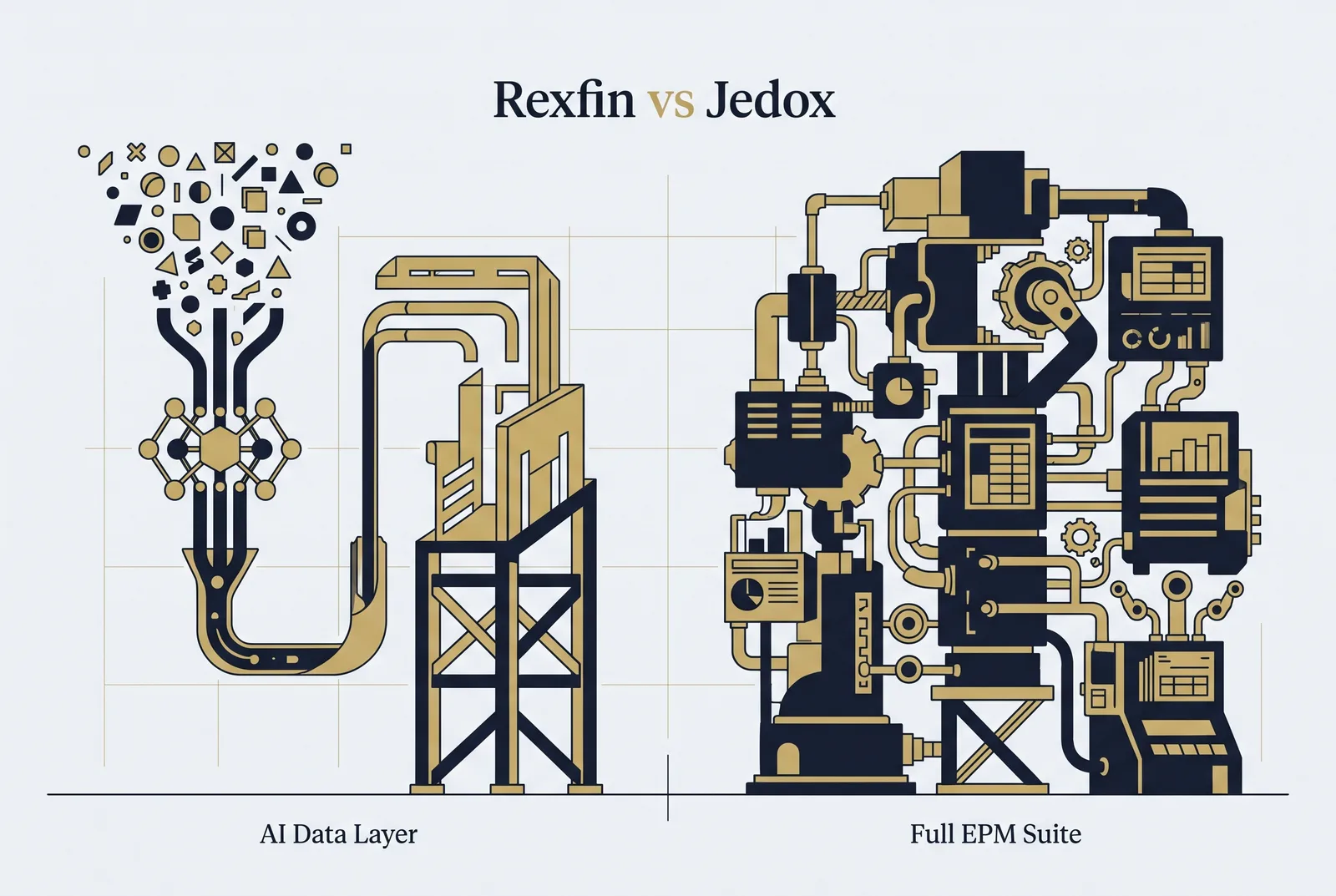
Jedox is a full FP&A and enterprise performance management suite. It fits mid-market to large enterprises running multidimensional, cross-functional planning, where FP&A, controllers, HR, sales, and operations all contribute to one plan. Rexfin is narrower on purpose. It’s the deterministic layer that guarantees every number an AI agent returns reconciles back to the ledger, without asking you to rebuild your data in a new platform first.
At a glance
| Jedox | Rexfin | |
|---|---|---|
| Core job | FP&A and EPM planning suite | Reconciled financial model that AI can query |
| Best for | Enterprises with cross-functional, high-volume planning | Teams putting AI on top of financial data |
| AI approach | JedoxAI: predictive insights and recommendations inside the plan | AI retrieves exact figures and calculates deterministically |
| Data reconciliation | Handled once data is modeled into Jedox cubes | Built in; every figure ties to the source |
| Where numbers come from | Governed multi-cube models built in Jedox | Reconciled model linked to ERP, accounting, and uploads |
| Setup | Model your data into cubes; expertise needed | Connect sources, reconcile, query |
| Pricing model | Quote-based, enterprise licensing plus partner implementation | Demo-led, contact for pricing |
Where Jedox is strong
Jedox earned its Gartner Magic Quadrant Leader position on real modeling depth. Its multi-cube architecture handles real-time consolidation across models, so financial and operational drivers sit in one governed structure rather than a pile of disconnected sheets. The in-memory calculation engine keeps large multidimensional models responsive, which matters when thousands of contributors touch the same plan.
The Excel Add-in with live write-back is a genuine differentiator. Finance teams keep working in the interface they know while their inputs flow into centralized, governed data instead of a private file. Microsoft 365 Add-ins extend that into Word and PowerPoint for board decks, and no-code modeling lets planners build without engineering help. When the logic gets hairy, Groovy and JavaScript scripted transformations and the Jedox Integrator (ETL) give power users room to move. The Jedox Marketplace ships best-practice accelerators so teams don’t start from a blank cube.
On governance, Jedox is serious. Approval workflows, access logs, full audit trails, and version control are built for finance that has to pass an audit. JedoxAI is marketed as explainable and governed, with every insight following the customer’s own business logic, so recommendations and anomaly detection stay traceable rather than opaque. If your problem is “we plan across many functions and need one governed system to hold all of it,” Jedox is a strong answer.
Where Jedox leaves gaps
The gaps show up around setup and where the AI’s trusted context actually comes from.
Multi-cube modeling and advanced scripted logic take modeling expertise to stand up. That’s the price of the flexibility, but it means value arrives after a project, often partner-led, not after an afternoon. Pricing stays quote-based with limited public transparency, so budgeting runs through a sales cycle. And JedoxAI, while promising, is relatively new compared with incumbents’ AI maturity.
The structural point is where AI gets its context. JedoxAI reasons over Jedox’s own governed cubes, which means the data has to be modeled inside Jedox before the AI can be trusted on it. Jedox is candid about the surrounding risk. Its own team blogs about “AI lock-in: the hidden threat undermining human expertise.” The implicit limit of “structured for AI that delivers” is that AI only delivers once your organization has rebuilt its numbers in Jedox’s structure. Anything outside those cubes, a source system you haven’t modeled yet or a figure that lives in the ERP, isn’t part of the trusted context an AI reads from.
That’s the exact seam an AI layer cares about. An agent answering a CFO’s question needs numbers that tie to the source of record, not just numbers that tie to whatever has been loaded into a cube.
Where Rexfin is different
Rexfin starts from the data, not the planning UI. It connects your accounting, banking, and warehouse sources, or ingests uploaded statements, then builds one reconciled model where every figure ties back to its origin in the ledger. Reconciliation is the product, not a step you configure after modeling. You don’t rebuild your data in a new cube structure to make it trustworthy; the trust comes from the tie-back itself.
The payoff shows up the moment AI touches the numbers. Instead of an LLM estimating revenue from context, a deterministic engine does the math and the AI only retrieves and reasons over the reconciled model. Ask for last quarter’s gross margin by entity and you get the reconciled figure, traceable to source, not a plausible-looking total. This is what makes AI safe to point at financial data. If you’re weighing where AI actually belongs in a finance stack, our take on the reliable financial-modeling layer for AI covers why the deterministic layer sits under the AI, not inside it.
Rexfin is not trying to be a full FP&A suite. It’s the trustworthy data and modeling foundation underneath one. Jedox builds the whole planning platform and adds governed AI on top; Rexfin builds the thin reconciliation layer that any AI can stand on.
Which should you pick
Pick Jedox if you need a full EPM suite: cross-functional planning across finance, HR, sales, and operations, governed multi-cube consolidation, Excel write-back, and audit-grade workflows, and you can invest in modeling your data into the platform.
Pick Rexfin if your priority is getting AI to answer financial questions with numbers that tie out, fast, without rebuilding your data inside a new modeling structure. The two aren’t mutually exclusive. Plenty of teams keep Jedox as their planning system and use Rexfin as the reconciled layer that feeds reliable, source-traceable figures to their AI agents.
Want to see exact figures retrieved live from a reconciled model? Book a demo and bring your own numbers.
FAQ
Is Rexfin a replacement for Jedox? Not usually. Jedox is a full FP&A and EPM platform; Rexfin is the deterministic reconciliation and modeling layer that makes AI reliable on financial numbers. Many teams run both, with Rexfin feeding source-traceable figures alongside Jedox’s planning cubes.
How is Rexfin’s context different from JedoxAI’s context? JedoxAI reasons over data that has been modeled into Jedox’s governed cubes. Rexfin reconciles your existing sources directly, so the AI’s context ties back to the ledger without requiring you to rebuild your numbers in a new platform first.
Do I have to model my data into cubes to get value from Rexfin? No. Rexfin connects to your accounting, banking, and warehouse systems, or ingests uploaded statements, and reconciles them into one model. There’s no multi-cube modeling project before you can start querying.
In practice
While you evaluate Jedox, this is what a verified number looks like.
Export review
FY2025 board pack.xlsx
- 2 extractors agree
- Reconciles to printed total
- Identity checks pass