
Agentic FP&A Is Coming. Your Agents Need a Reconciled Foundation, Not Just Autonomy
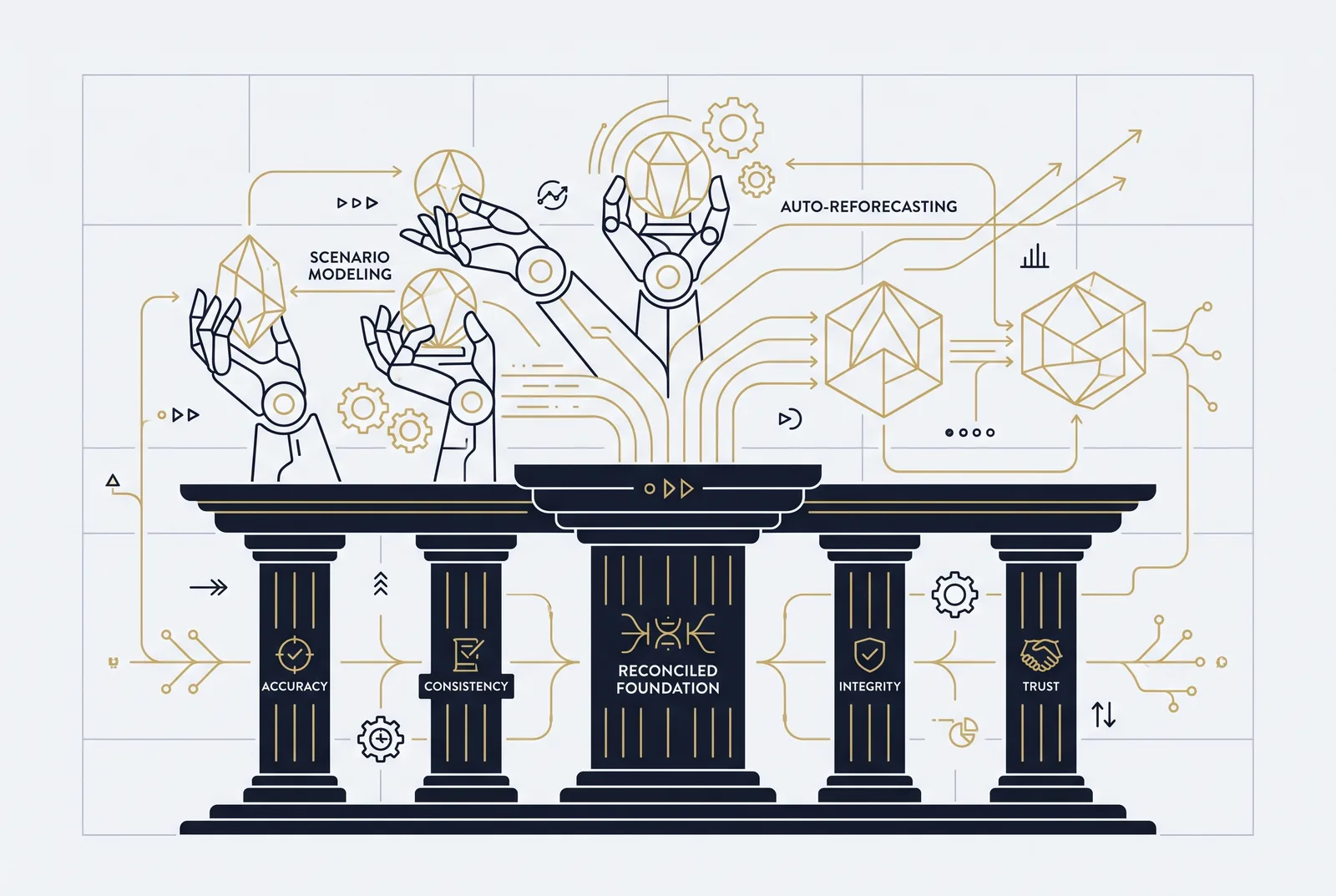
Auto-reforecast agents are powerful and dangerous. On unverified figures they compound error at machine speed. The reconciled model is what makes them defensible.
By The Rexfin team
Picture the demo everyone in finance has now seen some version of. New actuals land. An agent notices that gross margin slipped two points against plan, reforecasts the rest of the year on its own, spins up a downside scenario, drafts the variance commentary, and pings the FP&A lead before anyone has opened a spreadsheet. It takes ninety seconds. It looks like the future.
Now change one thing. The actuals the agent read came from a QuickBooks pull that hadn’t been reconciled against the bank feed, and revenue was overstated by a rounding-plus-timing mess worth about three percent. The agent didn’t know that. It reforecast on the inflated base, the downside scenario was downside-from-the-wrong-number, and the commentary it drafted was articulate and false. The ping went out anyway.
That second version is not a hypothetical. It’s the default outcome when you point an autonomous agent at finance data that hasn’t been put right first.
Why agents make bad data worse, not just visible
A single-shot AI answer fails in one place. You ask for the margin, it gives you a wrong margin, you catch it or you don’t, and the damage is contained to that one reply.
An agent doesn’t stop at one reply. It chains. The reforecast consumes the bad actuals. The scenario consumes the reforecast. The recommendation consumes the scenario. The triggered action consumes the recommendation. Each step is a multiplier on whatever was wrong at the start, and each step looks just as polished as a correct one would.
This is the part that should keep a CFO up at night, and it has nothing to do with whether the model is smart. A more capable model reasons more fluently over the wrong inputs. It does not check whether the inputs tie to the ledger, because nothing in a language model’s training tells it your Xero balance is stale. Speed plus autonomy plus unverified data is not productivity. It’s a faster path to a defensible-sounding mistake.
What auto-reforecast actually requires
The features people want from agentic FP&A are real and worth having:
- Auto-reforecast when actuals diverge from plan past a set threshold.
- Scenario triggers that fire a what-if when a driver (pipeline, churn, FX) moves.
- Continuous variance monitoring instead of a once-a-month manual review.
Every one of these depends on the same precondition: the numbers the agent reads have to be correct, consistent, and traceable. Not approximately. An agent that reforecasts weekly is reading your data fifty-two times a year unsupervised. The reconciliation a human used to do quietly at each close has to happen before the agent ever looks, or it doesn’t happen at all.
The foundation: one reconciled model
This is the work Rexfin does before any agent gets involved. You connect your accounting platform or warehouse (QuickBooks, Xero, NetSuite, Sage) or upload statements, and Rexfin builds a single reconciled financial model that ties out to the ledger. One definition of revenue. One definition of margin. Numbers that agree with the source of record, not three spreadsheets that each tell a slightly different story.
That reconciled model is the foundation the whole pillar argues for. We make the broader case in Single Source of Truth: Why Reconciled Data Is the Real Unlock for AI in Finance. When every agent, query, and scenario reads from the same reconciled model, the compounding problem changes character: each step in the chain inherits correct inputs instead of inherited error.
Keep the math away from the model
Reconciled inputs solve half the problem. The other half is the arithmetic itself. If you let the language model compute the reforecast (even inside a sandbox), you’ve handed the most consequential step to the component least suited to it. Generated code runs cleanly and is still wrong when the model picked the wrong formula or the wrong inputs. We dig into exactly why in Why ‘Just Use a Code Interpreter’ Doesn’t Make AI Finance-Safe.
Rexfin draws the line differently. Retrieval pulls figures from the reconciled model. A deterministic engine runs the calculations: the same inputs always produce the same forecast, every time, with no model temperature in the loop. The agent orchestrates: it decides a threshold was crossed, it chooses which scenario matters, it writes the commentary. It never does the math, and it never invents a number.
That division of labor is what makes the ninety-second demo defensible instead of dangerous. When the board asks how the agent got to its reforecast, you can trace every figure back to a ledger entry and show the engine that computed it. There is no “the AI estimated it” in that answer.
The honest limits
A reconciled foundation doesn’t make agentic FP&A risk-free, and it would be dishonest to claim it does. Garbage in the source ledger is still garbage: reconciliation surfaces mismatches, it doesn’t fabricate the truth your books never recorded. Judgment calls about which scenario to act on still belong to people. And you still want a human in the loop before an agent’s output triggers anything that touches money or goes to a board.
What the foundation does is narrow the failure surface to things you can see and govern. It takes the most dangerous failure (silent, compounding, untraceable error) off the table. That’s the difference between a tool you can put in production and a demo you can only show.
The takeaway
Agentic FP&A is coming regardless of whether your data is ready for it. The question isn’t whether to give your agents autonomy. It’s whether you give them autonomy on top of a reconciled model that ties to the ledger, or on top of exports nobody verified. The first is a force multiplier. The second multiplies your mistakes at machine speed.
This article sits inside our pillar on agentic AI in finance, which makes the full case for the numbers layer that has to come first. If you’re piloting reforecast or scenario agents and want to see them run on a reconciled foundation, book a demo.
Part of Agentic AI in Finance Needs a Reliable Numbers Layer First