
UAE Corporate Tax, Transfer Pricing, and a 14% Interest Clock: Why AI Tax Workpapers Have to Reconcile First
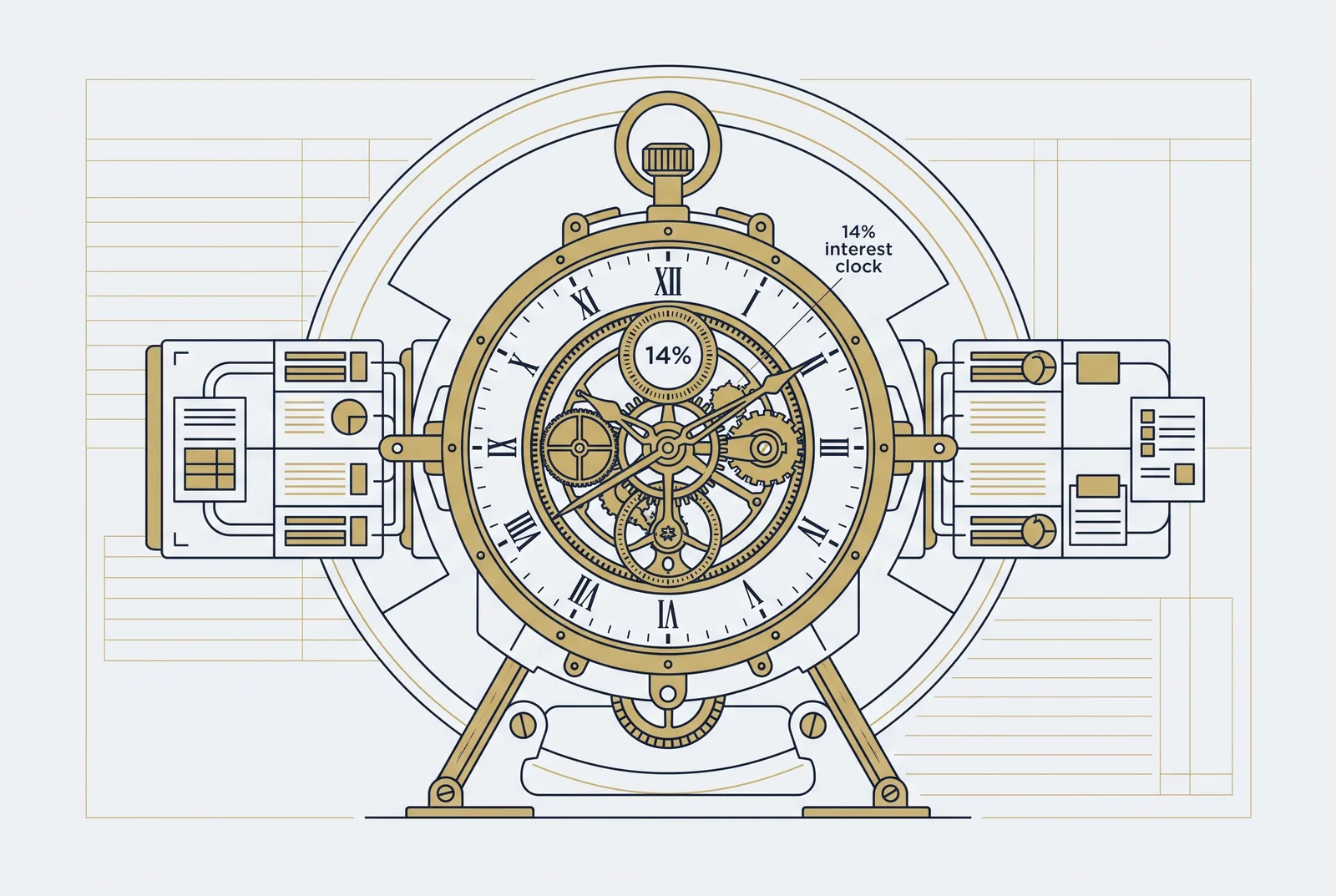
UAE corporate tax now carries a 14% annual interest charge on underpaid tax. AI that drafts tax positions on unreconciled data is a penalty waiting to happen. Reconcile first.
By The Rexfin team
A finance team in Dubai asks an AI assistant to draft the corporate tax computation. It reads from the management accounts, pulls related-party balances from a spreadsheet someone exported last quarter, and produces a clean schedule with a taxable income figure and a tax charge at 9%. The numbers look defensible. They are also wrong, because the spreadsheet was three intercompany eliminations out of date and nobody noticed. Under the rules taking effect in 2026, that mistake is no longer a quiet adjustment. It is a 14% annual interest charge on the underpaid tax, running until it’s settled.
That is the part that changes the calculus on AI in UAE tax. The technology is good enough to write the workpaper. It is not good enough to know whether the data underneath the workpaper ties to anything real. And the Federal Tax Authority has just made the cost of that gap explicit.
What actually changed
Two things matter here, and they compound.
First, the price of being wrong went up and got cleaner. Cabinet Decision No. 129 of 2025 replaced the old compounding penalty structure with a flat interest charge of 14% per annum on overdue tax, effective from 14 April 2026. The old model layered an immediate percentage plus monthly compounding that could, in theory, spiral toward multiples of the original tax. The new one is simpler to understand and, for a CFO, easier to model: roughly 1.17% a month on whatever you underpaid, accruing on the tax itself. Simpler does not mean softer. A modest error on a large base, left to run across a filing cycle, is real money.
Second, the documentation burden around related parties is now a fixed expectation, not a future threat. UAE corporate tax sits at 9% above the threshold. On top of that, groups crossing the transfer pricing documentation thresholds (broadly, UAE revenue at or above AED 200 million, or global group revenue around AED 3.15 billion) have to maintain a Master File and Local File and produce them to the FTA, typically within 30 days of a request. Separately, related-party transactions above AED 40 million in aggregate trigger disclosure-form obligations. (Confirm the exact figures and timing against the current FTA guidance for your group; thresholds and forms get revised.)
Read those two together. You have a tax base that depends heavily on intercompany pricing and eliminations, a documentation regime that demands you show your working, and an interest clock that punishes the gap between what you reported and what you should have. This is exactly the environment where unverified automation does the most damage.
Where AI breaks on tax data
The failure isn’t that language models can’t do tax. Many of them reason about the rules competently. The failure is upstream, in the data they reason over.
Ask an AI for “related-party revenue for the year” and it will answer from whatever it can reach: a management report, a stale extract, a cell in a deck. It has no concept of whether that number survived consolidation, whether the matching intercompany cost sits in the counterparty entity, or whether the elimination ran. It produces a figure with the same confidence whether the figure is reconciled or fictional. For a Local File or a tax computation, that confidence is a liability. The FTA does not assess your prompt. It assesses your return.
The arithmetic problem is real too. Letting a language model perform the tax math (apportionments, the interest deduction limitation, deferred tax movements) means accepting probabilistic output where you need deterministic output. A model that’s right 98% of the time is wrong often enough to generate the exact underpayment that the 14% interest charge is built to catch. Tax math has to be computed, not predicted.
Reconcile first, then let AI read
The fix is not to keep AI away from tax work. It’s to change what AI reads from. This is the layer Rexfin is built to be.
Rexfin connects to the systems where the numbers actually live (QuickBooks, Xero, NetSuite, Sage, SAP, Oracle, data warehouses) or to uploaded statements, and builds one reconciled financial model that ties out to the ledger. Intercompany balances net. Eliminations are applied and visible. The consolidated base is a single source of truth rather than a pile of extracts that disagree with each other. Only then does AI get to work, and it works against that model, not against whatever document happened to be open.
When the figures come from a reconciled base, the rest follows with a property tax teams should insist on: traceability. Every number an AI surfaces for the computation points back to the ledger entries that produced it. When the FTA asks how you arrived at related-party revenue for the Local File, the answer is a trace to source, not a recollection of a spreadsheet.
The calculations matter just as much as the data. Rexfin runs the math through a deterministic engine rather than the model. The AI retrieves the figures, frames the question, explains the result in plain language, but the apportionment, the limitation tests, the consolidated totals are computed the same way every time. Two things that should match, match. Ask the same question twice, get the same number twice. That reproducibility is what makes a workpaper a workpaper instead of a draft you have to re-check by hand.
What-if then becomes safe rather than scary. You can model the effect of a different intercompany margin on the taxable base, or test how an adjustment moves the interest exposure, knowing the scenario runs off the reconciled model and traces back to real numbers. That’s the difference between using AI to explore a position and using it to invent one.
The honest limit
None of this turns the tax return into a button. Rexfin doesn’t decide your transfer pricing policy, doesn’t replace the judgment of your tax advisor, and doesn’t make the arm’s-length question go away. Pricing intercompany transactions correctly is still professional work. What the reconciled layer removes is a specific, expensive class of error: the one where the AI is reasoning fluently over numbers that were never true. It guarantees the inputs and the arithmetic. The position is still yours to defend, but now you can.
There’s also a transition cost. Getting to one reconciled model means confronting the eliminations and intercompany mismatches that an export-and-hope workflow lets you ignore. That work is the point. It’s cheaper to do it before the return than to discover it at 14% a year afterward.
The takeaway
The UAE has made the cost of an unverified number measurable. An AI tax workpaper is only as trustworthy as the data it reads and the engine it computes with. Drafting positions on unreconciled extracts was always sloppy; with a 14% interest clock running from April 2026, it’s expensive sloppy. Build the reconciled model first, let AI read and calculate against it, and keep the trace back to source for the day the FTA asks.
If your group is heading into a UAE corporate tax cycle with intercompany complexity and AI in the workflow, book a demo and we’ll show you what your tax figures look like when every one of them ties to the ledger.
For the wider picture, see the pillar on building a trusted numbers layer for AI finance in the GCC. Two neighbors are worth reading next: whether your AI can tie every number back to the FY2025 audit, and how one reconciled model holds across 40 SPVs on Vision 2030 projects.
Part of AI in Finance for the GCC: A Trusted Numbers Layer