
Driver-Based Forecasting With AI: Define the Levers, Let the Math Stay Deterministic
AI can refresh actuals and surface risk, but the driver math that turns inputs into revenue and cash must be deterministic and reconciled, not re-derived by an LLM.
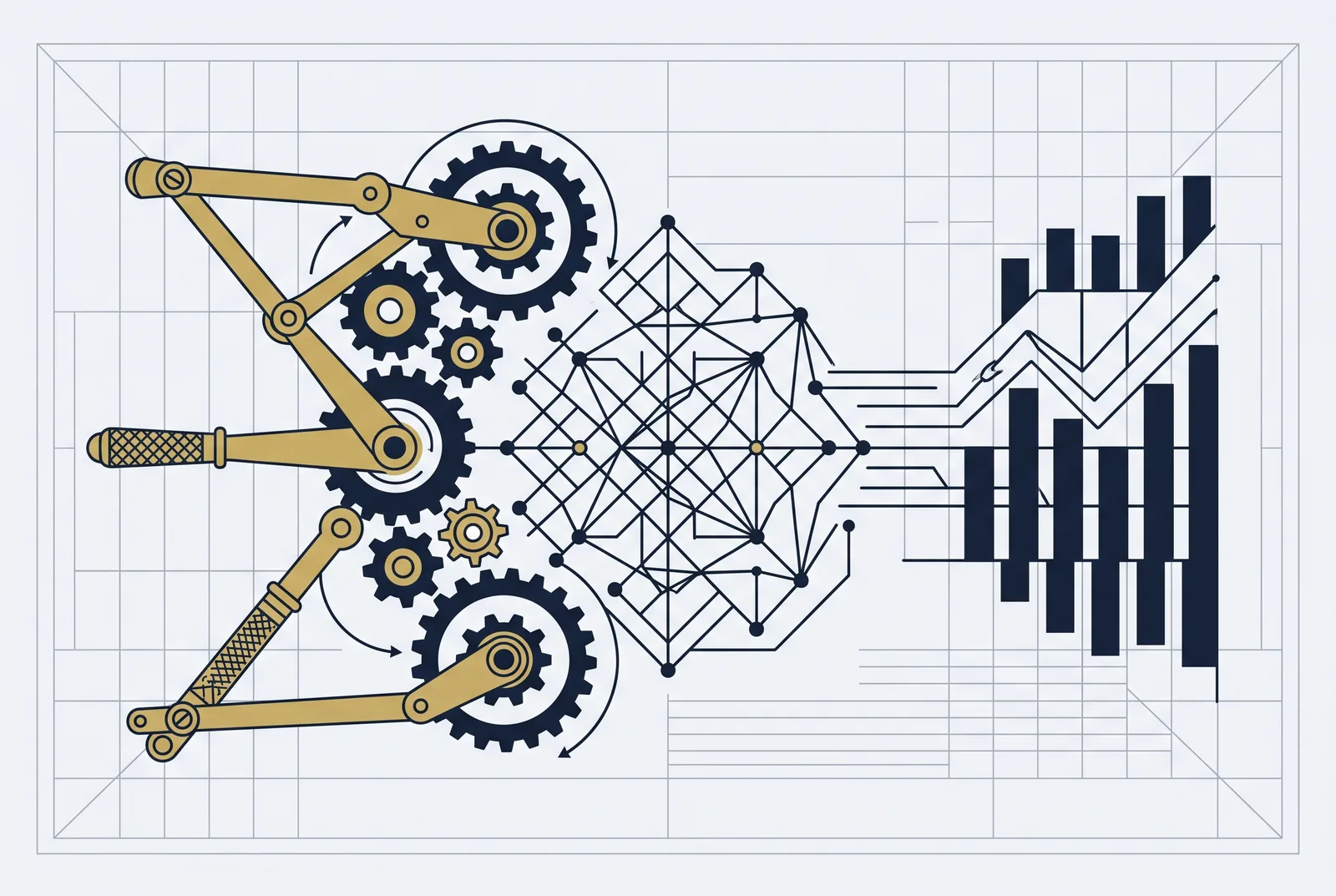
By The Rexfin team
A sales lead closes 40 net-new logos in a quarter instead of the 30 you planned. What does that do to next-quarter revenue, to headcount in onboarding, to cash by June? In a driver-based model the answer is mechanical: units times average contract value times ramp curve, minus the churn you assumed, flowing into a cash conversion schedule. The number falls out of the structure. Nobody re-argues the arithmetic.
That mechanical quality is exactly what most teams lose the moment they bolt an LLM onto forecasting. The model writes a plausible-looking projection, and a plausible-looking projection is not the same thing as a correct one.
What driver-based actually buys you
Driver-based planning ties your forecast to the operational levers that move the business, not to a line that grows revenue 3% because last year grew 3%. Pipeline coverage, conversion rate, average deal size, ramp time, gross retention, billings-to-cash lag. You change a driver, every downstream figure recomputes.
The payoff is real and measured. Teams running driver-based models report forecast accuracy improvements in the 25-30% range and roughly 20% shorter planning cycles, and high-performing FP&A functions cite driver-based modeling as a defining trait, with most rating their forecasts good or great. Yet only about 17% of organizations run fully driver-based models, and a far smaller slice, around 2%, combine it with AI in any dynamic way. There’s a lot of headroom, and a lot of room to do it badly.
The reason adoption lags isn’t that people doubt the value. It’s that building and maintaining the driver relationships is tedious, and keeping them tied to actuals is worse. Which is precisely where AI looks tempting, and precisely where the temptation needs a hard boundary.
The split: reasoning is probabilistic, math must not be
Here’s the distinction that decides whether your AI forecast survives a board meeting. There are two kinds of work in a forecast.
The first is judgment and language: reading last month’s actuals, noticing that win rates dipped in one segment, drafting the assumption that ramp will slow, flagging that DSO crept up. LLMs are genuinely good at this. Pattern-spotting across messy inputs and writing a clear sentence about it is what they do.
The second is computation: applying the driver formula, compounding it across twelve periods, rolling it into a three-statement model so the cash line is consistent with the P&L. This is where LLMs break. Recent finance benchmarks put even the strongest models around 82% accuracy on spreadsheet tasks, roughly one error every six questions, and studies attribute a large share of failures, on the order of 40%, specifically to calculation and reasoning mistakes: unit confusion, percentage-versus-absolute slips, rounding drift, sign errors on cash flows. An 18% error rate is a non-starter when each number compounds into the next period and feeds a cash forecast a board will act on.
So the rule is simple. Let the AI define and adjust the levers. Do not let it compute them.
When a driver formula is re-derived by a language model on every run, you also lose the one property a forecast needs most: it stops being reproducible. Run the same prompt twice, get two slightly different revenue lines. A deterministic engine gives you the opposite guarantee. Same inputs, same drivers, same answer, every time. That’s how a formula behaves, and a forecast should behave like a formula.
How Rexfin draws the line
This separation is the whole point of a financial-modeling layer that sits underneath the AI rather than inside it.
Rexfin connects to your accounting and planning systems, QuickBooks, Xero, NetSuite, Sage, the data warehouse, or uploaded statements, and reconciles them into one financial model that ties out to the ledger. That reconciled model is where the drivers live. Conversion rate, ACV, ramp, retention, billings lag: each is defined once, as an explicit relationship, against numbers that already agree with the books.
When AI enters, it operates against that layer instead of around it. It ingests the latest actuals and updates the driver inputs. It can propose that a ramp assumption looks stale given three months of hiring data. It surfaces the segment where win rate is sliding before it dents the forecast. What it does not do is the multiplication. The driver math runs through Rexfin’s deterministic engine, the same code path every time, so a 12-month revenue build is calculated, not narrated.
That means every figure in the forecast traces back to a source. A controller can click from the projected Q3 revenue line to the driver that produced it, to the reconciled actuals that fed the driver, to the ledger entry underneath. The AI’s contribution, the judgment and the language, is auditable and overridable. The math is provable.
What this looks like in practice
Treat the AI as the analyst who keeps the model current and flags what changed, and treat the engine as the model itself. The analyst can be brilliant and occasionally wrong; the model has to be right by construction.
Done this way, driver-based forecasting and AI reinforce each other instead of fighting. The AI removes the tedium that kept adoption at 17%, refreshing actuals and re-flagging assumptions on every close. The deterministic layer keeps the forecast defensible, because a number that recomputes the same way each time is a number a CFO can sign. This is the same discipline behind continuous, always-current forecasting and behind what-if scenarios answered at the speed of a board question: the levers move, the math holds. It also explains where AI genuinely earns its place in FP&A today, which is the narrative, not the numbers. For the full picture, see the AI FP&A automation pillar.
The takeaway is narrow and worth holding onto. AI belongs in your forecast, but not in the arithmetic. Let it define the levers, watch the actuals, and write the story. Put the math on a deterministic, reconciled layer that produces the same answer twice. That’s the version you can put in front of a board without crossing your fingers.
See how Rexfin keeps driver math deterministic and traceable: book a demo.
Part of AI FP&A Automation: Forecasting You Can Defend in the Board Room