
Confidence Scores Are Not Enough: What Real Grounding Looks Like in AI Finance
Self-reported AI certainty and uncertainty-aware RAG help, but both still misfire on tables. Durable trust comes from grounding every figure in one reconciled model.
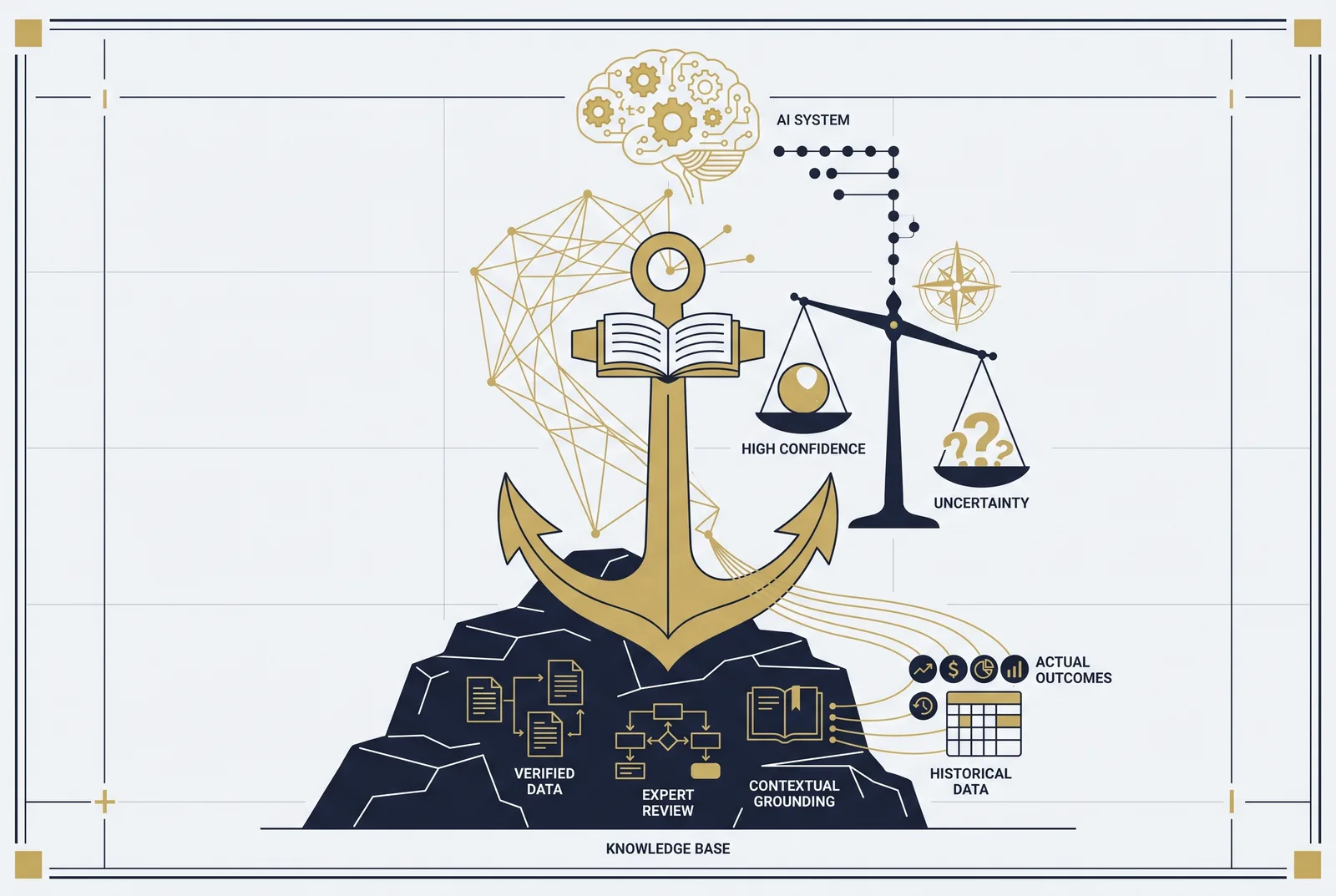
By The Rexfin team
A model tells you it is 94% confident that Q3 gross margin was 41.2%. The real figure, sitting in the ledger, is 38.7%. The confidence number was not a measure of correctness. It was a measure of how fluent the wrong answer sounded.
This is the trap most finance teams walk into when they start trusting AI with numbers. The output comes wrapped in a percentage that looks like a probability, and a percentage that looks like a probability feels like a control. It isn’t one. A confidence score tells you how sure the model is of its own guess. It tells you nothing about whether the guess ties to your books.
What a confidence score actually measures
Large language models are reliably miscalibrated, and the dominant failure mode is overconfidence. That pattern holds across a wide range of tasks, models, and datasets, and while a model can look well-calibrated on a clean, in-distribution prompt, that calibration is brittle and collapses the moment the input drifts away from what it saw in training. Financial tables drift constantly: merged cells, footnote-adjusted subtotals, mixed units, restated comparatives.
There is a more unsettling finding underneath this. Recent work on hallucination detection in finance shows that high token confidence can paradoxically predict higher hallucination risk, not lower. The model is most assertive at exactly the wrong moments. So the instinct to filter answers by “only show me figures above 90% confidence” can preferentially surface the fabrications.
That is the core problem with treating self-reported certainty as a gate. You are asking the system that produced the error to also grade the error. A skeptical CFO would never accept that arrangement from a human analyst, and there is no reason to accept it from a model.
Uncertainty-aware RAG is better, and still not enough
The obvious next move is to stop asking the model what it thinks and start grounding it in retrieved documents. Retrieval-augmented generation does reduce hallucination compared with relying on the model’s parametric memory, and the newer uncertainty-aware variants are a genuine step forward. A 2026 study on Bayesian RAG built epistemic uncertainty directly into retrieval using Monte Carlo dropout, reporting around 93% answer accuracy and roughly 27% better uncertainty calibration than baselines on Apple and Microsoft 10-K filings. That is real progress, and worth taking seriously.
But read what it measures. It quantifies how uncertain the retrieval is: whether the system pulled the right passage. It does not guarantee the number inside that passage was read correctly, that the right line item was selected from a table with forty rows, or that the arithmetic done afterward is sound. Most RAG implementations, even good ones, still produce confident-sounding answers when the underlying data is incomplete, irrelevant, or simply mis-parsed from a table. Retrieval grounding answers “where did this come from.” It does not answer “is the math right” or “does this tie to the ledger.”
For tables specifically, this gap is where the damage lives. A 10-K is mostly tables. The model can retrieve the correct page, cite it cleanly, and still hand you revenue from the wrong segment because two columns shared a header. The confidence will be high. The citation will be valid. The number will be wrong.
Real grounding ties to the books, not to the prompt
Here is the distinction that matters. There are two kinds of grounding, and the industry keeps conflating them.
The first is textual grounding: the answer points back to a source document. Useful, but a PDF is not the source of truth. It is a rendering of the source of truth, and often a degraded one.
The second is ledger grounding: every figure the AI returns resolves to a specific value in a reconciled financial model that ties out to the general ledger. Not a passage that mentions the figure, but the figure itself, with lineage back to the transactions that produced it.
Real grounding is the second kind. It changes what “verify” means. Instead of clicking through to a source document and re-reading a table the model already misread, the controller follows the number down through the calculation that produced it to the reconciled balances it draws on. The trust isn’t probabilistic. It’s structural.
This is the reconciled-numbers approach Rexfin is built around. We connect your accounting and financial-data systems (QuickBooks, Xero, NetSuite, Sage, your warehouse) or your uploaded statements, and build one reconciled model that ties out to the ledger. The AI doesn’t compute the margin. It retrieves figures from that model and runs the calculation through a deterministic engine, the way a formula in a controlled spreadsheet would. The answer comes back with a trace: which balances, which periods, which adjustments. No confidence score required, because the path is inspectable.
Why deterministic compute closes the last gap
Grounding the inputs is necessary but not sufficient. The other half is the math. Even when an LLM retrieves the correct numbers, it can still invert a ratio, confuse an absolute change with a percentage change, or flip the sign on a cash outflow, a class of error we cover in AI got the numbers right and the math wrong. A confidence score will not catch that. The arithmetic looked plausible to the model, so it was assertive.
Routing every calculation through a deterministic engine removes that failure entirely. The same inputs always produce the same output, and the result is replayable. That is what makes a figure defensible in front of a board or an auditor: not that the model was confident, but that the computation can be reproduced and traced. The same logic is why AI numbers belong in a board deck only after verification, and why the verification should be a structural check, not a vibe check on a percentage.
The takeaway
Confidence scores and uncertainty-aware retrieval are both real, both improving, and both insufficient on their own. They tell you how the model feels about its answer and where it looked. Neither tells you the answer ties to your books. For finance, that is the only question that counts.
Stop grading AI output by how sure the model sounds. Grade it by whether every figure resolves to a reconciled model, computed deterministically, traceable to source. That is grounding you can defend.
If you want to see what a figure looks like when it ties all the way down to the ledger, book a demo and bring a number your last AI tool got wrong.
Part of AI Hallucinations in Financial Data: Stop AI Inventing Numbers