
The Second GoBD Amendment: Why Machine-Readable AI Figures Now Rewrite Your Process Documentation
Germany's July 2025 GoBD update demands machine-evaluable records and an unbroken audit trail. Here is what that means for AI-generated finance numbers.
By The Rexfin team
On 14 July 2025 the German Federal Ministry of Finance published the second amendment to the GoBD, and it took effect the same day. No transition window. The headline change is dry on paper and brutal in a tax audit: records that are tax-relevant have to be available for machine evaluation (without further preparation, conversion, or massaging), and the process documentation behind them has to actually describe how those records came to be.
If you have started routing finance figures through an LLM, that one sentence should make you sit up. A number a model produced in a chat window, with no reproducible calculation logic and no trace back to the ledger, is not machine-evaluable in any sense the auditor recognizes. It is an assertion. And an assertion that cannot be reconstructed lands you in exactly the place every CFO wants to avoid: a qualified opinion, or the auditor refusing to rely on the figure at all.
What actually changed in July 2025
The amendment was driven mainly by Germany’s mandatory B2B e-invoicing regime, which started on 1 January 2025. The structured invoice, the XML core of a ZUGFeRD or XRechnung file, is now the original record you must retain in its machine-readable form. The human-readable PDF is decoration unless it carries additional tax-relevant information.
But the part that bites beyond invoicing is the reinforced standard on machine readability and process documentation. Two ideas sit at the center.
First, maschinelle Auswertbarkeit: machine evaluability. Tax-relevant data has to be exportable and analyzable in structured form (think CSV, JSON, or a proper data extract), and the tax authority can insist on evaluating it directly. Under indirect access (the Z2 path) the data now has to be prepared so the auditor’s own tools can run against it, if the examiner wants that. A locked PDF, a screenshot, a figure pasted into a slide: none of these clear the bar.
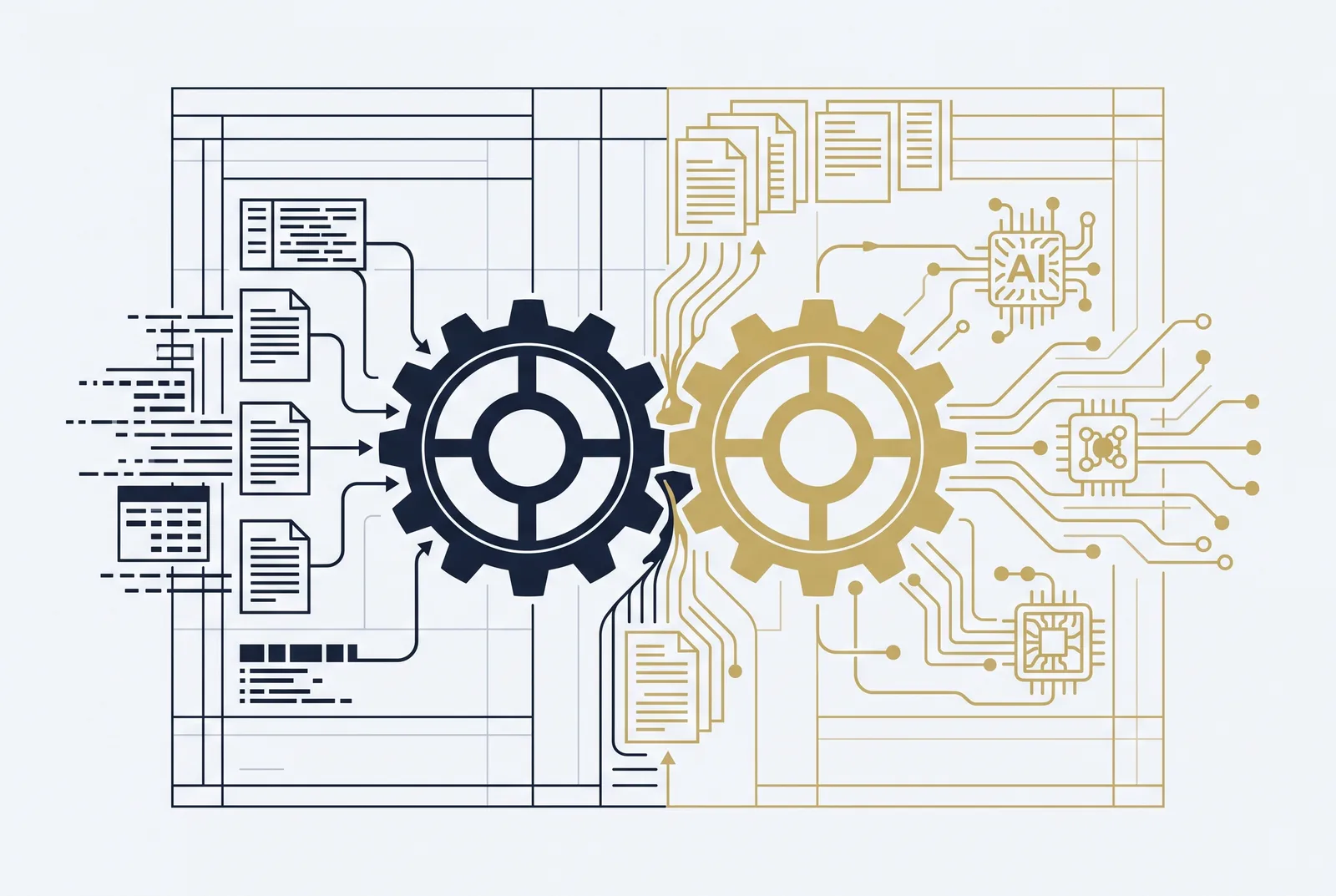
Second, Verfahrensdokumentation: process documentation. The amendment pushes it back into the spotlight. The authorities expect a current, audit-proof description of how data flows from source to financial statement: which systems touch it, what transformations happen, who approved what. If an AI system computes or adjusts a figure, that system is now part of the data pipeline you have to document. You cannot leave a black box in the middle of the chain and call the documentation complete.
Where AI quietly breaks the chain
The traceability principle, Nachvollziehbarkeit, has always been the spine of the GoBD. Every figure in the books should be reconstructible back to its source document, and the path between them should be visible. Tax audits have run on this for years.
Generative AI breaks the chain in a way that is easy to miss until the examiner asks the wrong question. An LLM is a probabilistic text engine. Ask it to compute a contribution margin or net working capital and it will produce a plausible number (sometimes the right one, sometimes a confidently wrong one), and it cannot give you a deterministic, repeatable derivation. Run the same prompt twice and the arithmetic path may differ. There is no stable calculation logic to document, because there isn’t one.
That is the trap the thesis behind this whole pillar keeps circling: an AI figure without a continuous audit trail and reproducible calculation logic walks you straight into the qualified-opinion territory at the next audit. The model didn’t lie, exactly. It just produced something that cannot survive Nachvollziehbarkeit. And the GoBD doesn’t grade on effort.
I’ll concede the obvious limit. None of this means AI has no place in finance. It means the AI cannot be the place where the math happens, and it cannot be an undocumented step in the pipeline. The fix is architectural, not a disclaimer in a footnote.
The fix: separate the language from the arithmetic
The cleanest way to stay inside the GoBD while still getting real value from AI is to stop asking the model to be a calculator. Let it do what it is good at (understanding a question, retrieving the right figures, explaining a result in plain language), and route every actual computation through a deterministic engine that produces the same answer every time and logs how it got there.
That separation is exactly what Rexfin is built around. We connect to your accounting and financial-data platforms (QuickBooks, Xero, NetSuite, Sage, SAP, Oracle, your warehouse) or to uploaded statements, and build one reconciled financial model that ties out to the ledger. A single source of truth, not a parallel set of numbers floating in a chat history. When the AI answers a question, it retrieves figures from that model, runs the calculation through the deterministic engine rather than the LLM, and every result traces back to the source line it came from.
For the GoBD that matters in two concrete ways:
- Machine evaluability is native. The reconciled model is structured data you can export and that an auditor’s tools can run against, no last-minute conversion scramble.
- The audit trail is the product, not an afterthought. Each figure carries its derivation: which source records fed it, which calculation produced it, when. That is the reproducible logic the amendment now expects you to document and reconstruct on demand.
It also makes the process documentation tractable. Instead of trying to describe the inner reasoning of a model that has no stable reasoning, you document a defined pipeline: source system, reconciliation, deterministic calculation, output. That is something an auditor can follow, and something you can actually keep current.
What to do before the next audit
Walk the path a tax examiner would walk. Pick a figure that an AI tool touched last quarter and try to reconstruct it from source documents, step by step, today. If you cannot (if the derivation lives in a deleted chat thread or in the head of one analyst), you have found your exposure before the auditor did.
The GoBD did not ban AI. It quietly raised the price of using it carelessly, and the bill comes due during a Betriebsprüfung. The institutions that come through clean will be the ones that treated the audit trail as infrastructure from day one, not as something to assemble under deadline.
If you want to see what a finance model with a built-in, traceable calculation layer looks like in practice, figures that tie to the ledger and a derivation behind every number, book a demo. We will run it against the kind of question an examiner would ask.
For the wider regulatory picture, see the pillar overview. Two neighboring pieces are worth your time: how your auditor evaluates AI-supported figures under IDW PS 861, and the human-oversight duty in Article 14 of the EU AI Act.
Part of AI in Finance, Audit-Proof: GoBD- and AI-Act-Defensible Models With Traceable Numbers