
Replayable by Design: How to Prove an AI Number the Same Way You Prove a Formula
Boards and auditors now want AI figures that replay identically and trace to source. Only a deterministic calculation layer beneath the LLM can deliver that.
By The Rexfin team
Click a cell in a spreadsheet and you can prove the number behind it. The formula bar shows the operation, the operation points at other cells, and those cells point at inputs. You can rebuild the figure by hand and get the same answer every time. That property has a name in audit work: it replays. Same inputs, same path, same result.
Now ask a language model the same question twice and watch what happens.
In one widely cited test, a 235-billion-parameter model produced 80 distinct completions across 1,000 identical runs, even with the temperature set to zero. Researchers studying the problem traced it to the hardware itself: rounding differences in floating-point arithmetic, plus non-deterministic GPU kernels in attention and normalization layers. Setting temperature to zero narrows the distribution. It does not close it. A model can disagree with itself about a number you will report to a board.
That is the gap this article is about. Not whether AI can be useful in finance, but whether an AI figure can be proven the way a formula can be proven. The answer depends entirely on where the arithmetic happens.
What “replayable” actually demands
When an auditor or audit committee says they want AI outputs to be auditable, they are usually asking for three things, even if they phrase it differently.
First, determinism: identical inputs produce an identical figure, today and in eighteen months when someone reopens the file. Second, traceability: every number has a path back to a ledger entry or a stated input, not a paraphrase of one. Third, independence: a second party can rerun the work and land on the same result within tolerance.
These are not new expectations invented for AI. They are the same controls finance has always lived under. What is new is that supervisory frameworks have started naming reproducibility explicitly. The EU AI Act’s auditability requirements for high-risk systems, the NIST AI Risk Management Framework, and U.S. banking guidance all lean on consistency under identical inputs. The COSO guidance on internal controls for generative AI, published in 2026, made the same point in the language of controls: “set and forget” does not work with probabilistic models, and monitoring becomes a control activity rather than an afterthought.
Some audit teams have gone further and written down what they will accept. Replication standards have appeared with explicit sampling cadence and a ±5 percent tolerance band for independent reruns. Read that carefully. A tolerance band is what you specify when you have already conceded the system cannot replay exactly. For a balance-sheet reconciliation, ±5 percent is not a rounding allowance. It is a hole.
Why the model can never be the calculator
The instinct, when faced with model variance, is to turn the temperature down and hope. We have watched teams do this and convince themselves it solved the problem. It reduces visible variance on short answers and hides the rest.
The deeper issue is conceptual. A language model predicts the next token. It is extraordinarily good at recognizing that a question is about gross margin and that gross margin involves revenue and cost of goods sold. It is not a calculator. When it “computes” 4,182,665 minus 3,114,209, it is producing a plausible sequence of digits, not executing subtraction. Most of the time the plausible sequence is correct. Most of the time is the problem. You cannot put “usually right” in a footnote.
A separate body of work on financial workflows calls the failure mode output drift: the same prompt run across providers, or across model versions, or just across a quiet Tuesday, returns figures that no longer tie out. Drift is invisible until reconciliation catches it, and reconciliation is exactly the step teams want to automate away.
So the model has to keep its real strength, language and intent, and surrender the one job it was never built for. The arithmetic has to move somewhere deterministic.
The layer that makes it provable
This is the design Rexfin is built around, and the reasoning is plain once you separate the jobs.
Rexfin connects to the systems your numbers already live in, including QuickBooks, Xero, NetSuite, Sage, SAP, Oracle, and your data warehouse, or uploaded statements. From those sources it builds one reconciled financial model that ties out to the ledger. That model is the single thing every figure is computed against. Why this matters is covered in the pillar on the reliable financial-modeling layer for AI, and the trap of treating a workbook as that foundation is the subject of why a spreadsheet is the wrong foundation for AI finance.
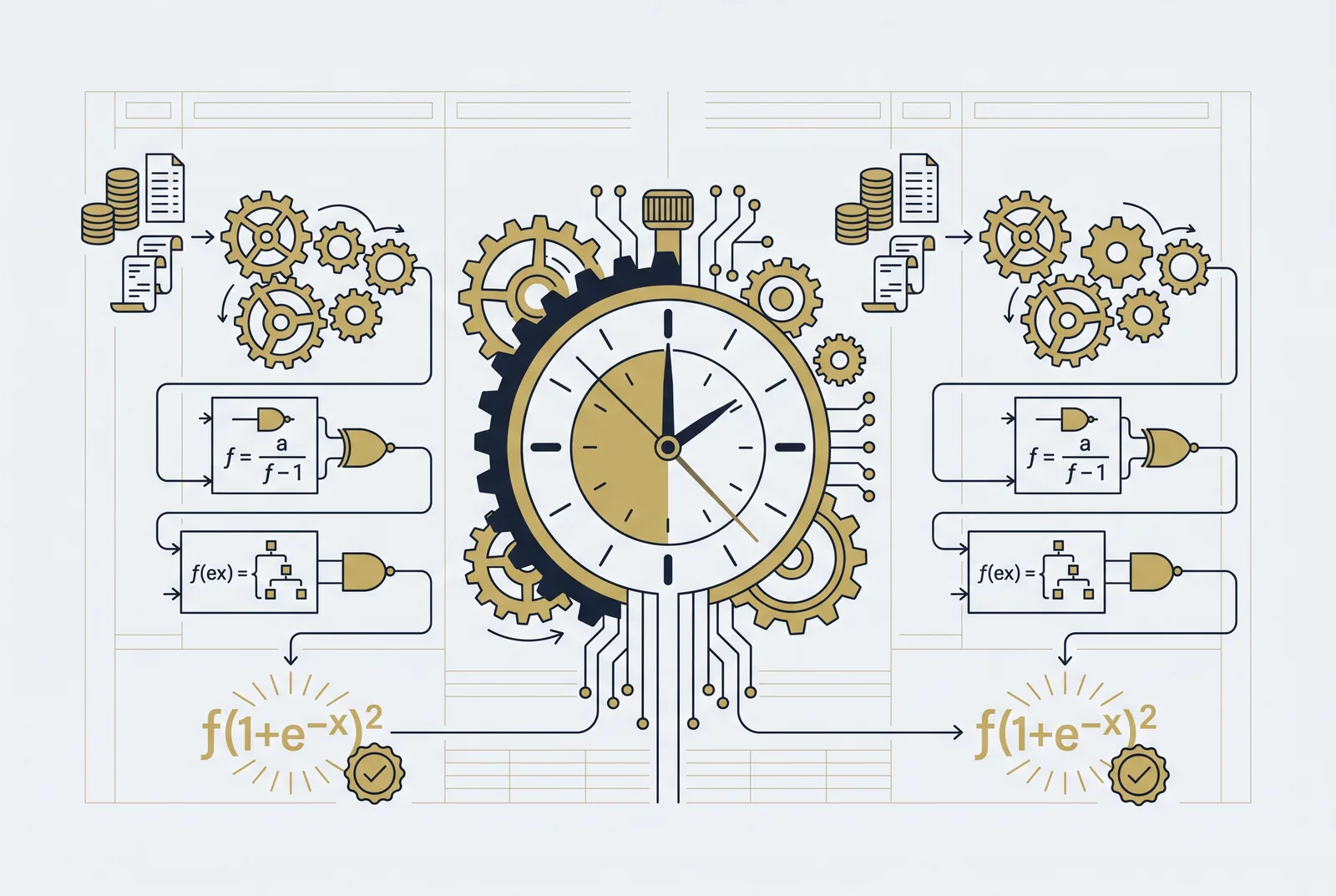
When you ask a question, the language model does the part it is good at: it interprets what you mean and chooses which figures and operations are relevant. The math itself runs through a deterministic calculation engine, not the LLM. The engine executes the operation against the reconciled model, returns the figure, and records the path from inputs to result. Run the same question next quarter against the same data and you get the same number. Hand it to a second reviewer and they get the same number. That is replayability in the spreadsheet sense, restored.
It is worth being precise about why connecting a model to your ERP through a protocol is not the same thing. A connection gives the model access to the data; it does not move the arithmetic off the model. We unpack that distinction in MCP for finance is not enough. Access without a deterministic engine just lets the model fetch real numbers and then do unreliable math on them.
What this changes in the room
Picture the audit conversation. Someone questions a figure in the management pack. With a model-in-the-loop approach, the honest answer is that the number was generated, probably correct, and not guaranteed to reproduce. That answer does not survive a control review.
With a deterministic layer, the answer is different. The figure traces to specific ledger entries. The operation that produced it is recorded. Rerun it and it returns the same value. You are no longer defending a generated number. You are showing your work, the way you would for a formula.
Scenario work gets the same treatment. When you model a what-if in Rexfin, the engine recomputes deterministically against the reconciled model, so a downside case you present to the board can be reproduced line by line rather than regenerated and quietly different. You can see how that plays out in real finance workflows on the use cases page.
None of this makes the model less valuable. It makes the model trustworthy by giving it a job it can actually keep: understand the question, narrate the answer, leave the arithmetic to a layer that replays. Strip everything else away and that is the whole argument. A number you cannot reproduce is not a number you can report.
If your team is being asked to put AI figures in front of an auditor or a board, the question to settle first is whether those figures replay. Book a demo and we will run one of your reconciliations through the deterministic engine, twice, and let you check the result against your ledger.
Part of The Reliability Layer AI Needs Before It Touches Your Numbers