
Cash Flow Forecasting: Why It Breaks, and What a Reconciled Model Fixes
Cash flow forecasting software keeps missing because opening cash is unreconciled and AI guesses. See how a reconciled modeling layer ties forecasts to source.
By The Rexfin team
The job, and why it breaks today
A cash flow forecast answers one question: how much money will the business have, and when. Get it right and you make payroll, time a raise, and hold vendors at arm’s length. Get it wrong and you find out the hard way.
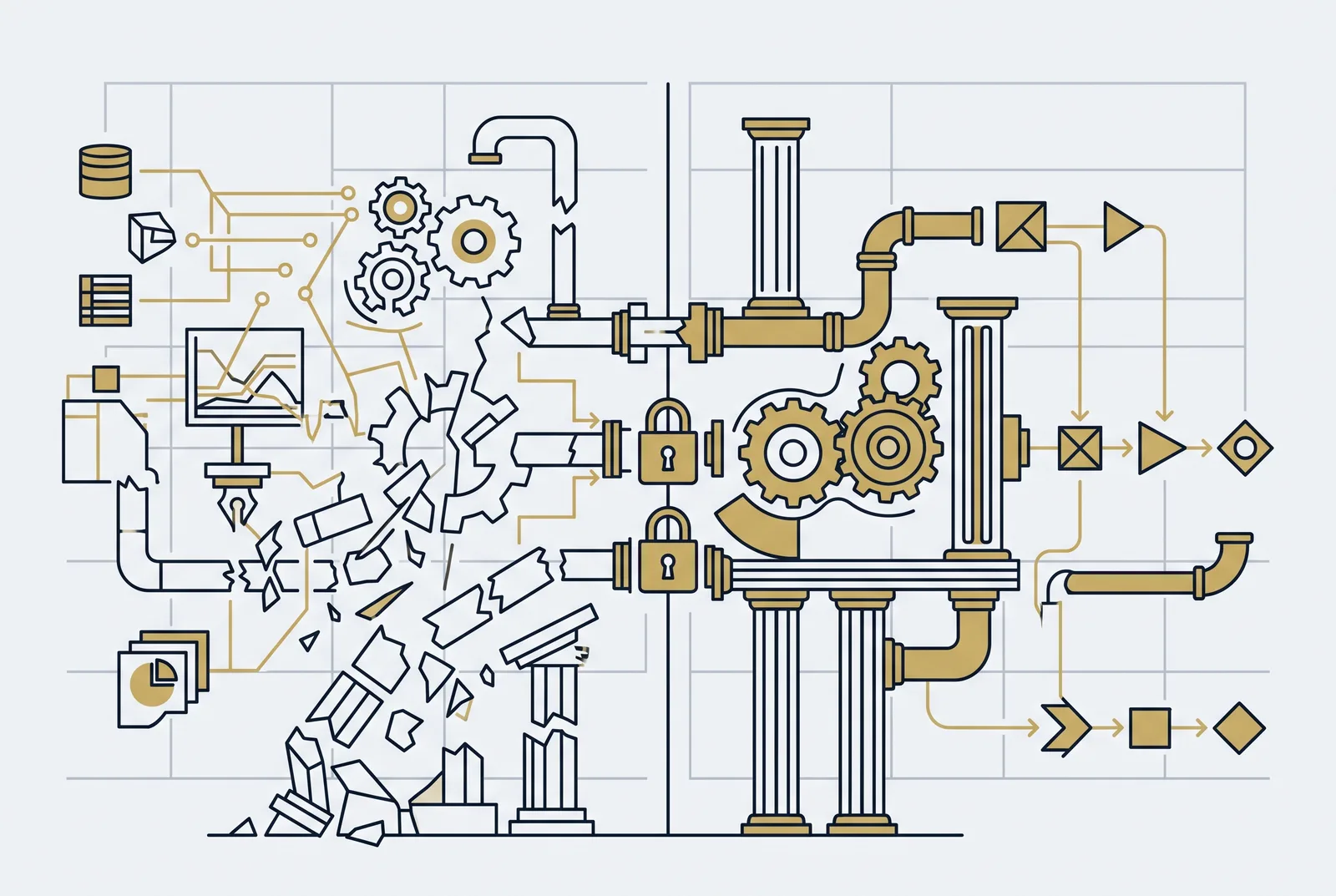
The job breaks at the very first cell. If the opening cash position is built on stale or unreconciled data, every week after it inherits the error. A forecast that starts wrong stays wrong, and the variance compounds the further out you look.
Then there’s the timing problem. Legacy tools average collections by category instead of predicting at the individual invoice level, so they miss when a specific large payment actually lands. Rolling windows make it worse. Each refresh means rebuilding the model by hand, which introduces lag and small mistakes right when volatility demands a weekly update.
The newest failure mode is the most dangerous. Teams now point an LLM at their numbers and ask it to forecast. The model reads a spreadsheet, pattern-matches, and returns a confident figure that nobody can trace to a source. It looks like analysis. It’s a guess with good grammar.
How FP&A tools handle it
The established planning platforms have real strengths here. Pigment and Cube connect live banking data and automate the rolling window, dropping completed weeks and adding new ones without a manual rebuild. Datarails keeps finance teams in the Excel they already know while syncing actuals underneath. Vena and Planful bring structured workflow, approvals, and a modeling environment built for FP&A. Abacum and Aleph push fast, collaborative planning for lean teams.
These tools are good at the planning surface. Where most still struggle is the foundation underneath the forecast: whether the opening cash figure was reconciled against the bank before anyone built on top of it, and whether the numbers an AI reads back are exact or approximate. A clean modeling interface on top of unverified data still produces a forecast you have to double-check by hand.
How a reconciled modeling layer changes it
Rexfin is the reliable financial-modeling layer for AI. It connects accounting and financial data across ERP, accounting systems, and spreadsheets, then reconciles it into one financial model. Opening cash is verified against the source before a single forward week is calculated.
That changes what AI can do with the data. Instead of an LLM reading a sheet and estimating, AI retrieves exact figures from the reconciled model, runs the cash math deterministically, and produces scenarios that recompute the same way every time. Ask for a 13-week view, a downside case, or the effect of a delayed receivable, and the numbers tie back to the source you can name.
Rexfin is not a full FP&A suite, and it doesn’t pretend to be. It’s the trustworthy data and modeling layer that sits underneath the tools you already use, so the forecast they produce stands on figures that reconcile.
Old way vs. a reconciled model
| Spreadsheet or AI-on-raw-data | With Rexfin’s reconciled model | |
|---|---|---|
| Opening cash | Pulled from stale or unreconciled sources | Verified against the source first |
| AI’s role | Reads a sheet and estimates a number | Retrieves exact figures, calculates deterministically |
| Forecast detail | Collections averaged by category | Modeled from reconciled, granular data |
| Rolling refresh | Manual rebuild, lag and errors | Recomputes against current data |
| Scenarios | One-off, hard to reproduce | Run on demand, same result every run |
| Auditability | ”Where did this come from?” | Numbers trace back to source |
What this gives a finance team
The payoff is trust in the first number and every number after it. When opening cash is reconciled and the model is deterministic, scenario planning stops being a quarterly fire drill and becomes something you run whenever a customer slips a payment or a deal closes early. The forecast moves from a document you defend to a tool you actually use for liquidity decisions.
AI becomes useful on financial data only when it stops guessing. A reconciled model is what makes that switch.
FAQ
How much does Rexfin cost? Rexfin prices as a data-and-modeling layer, not a full FP&A suite, so it typically sits below the planning platforms it feeds. Pricing scales with the connected systems and data volume: book a demo for a quote against your stack.
How long does setup take, and do I have to leave my current tools? No rip-and-replace. Rexfin connects to your ERP, accounting system, and spreadsheets and sits underneath the FP&A tools you already use. Most teams reconcile a first model in days, not quarters, because you’re wiring existing sources rather than rebuilding them.
How is my financial data kept secure? Data is connected read-only from source systems and used to build the reconciled model; Rexfin doesn’t write back to your ledgers. Access is scoped to your team, and because every figure traces to a named source, you can audit exactly what was read and when.
Why is a reconciled forecast more accurate than an AI-on-spreadsheet forecast? Accuracy breaks at the opening cash cell. Rexfin verifies opening cash against the bank before any forward week is calculated, then AI retrieves exact figures and runs the cash math deterministically instead of pattern-matching a sheet. Same inputs produce the same forecast every run, and every number ties back to source.
See how your cash forecast holds up on reconciled numbers: book a demo.
In practice
While you evaluate Cash Flow Forecasting, this is what a verified number looks like.
Export review
FY2025 board pack.xlsx
- 2 extractors agree
- Reconciles to printed total
- Identity checks pass
See also
- Board and Management Reporting for Finance
- Budget vs Actual Variance Analysis: Why It Breaks, and How to Fix the Data Layer
- Driver-Based Planning: Why It Breaks, and What Fixes It
- Month-End Close Automation: From Manual Reconciliation to a Reconciled Model AI Can Trust
- Workforce & Headcount Planning: Reconciled Data, Exact Numbers