
Rexfin vs Abacum: Reconciled Data Layer vs AI-Native FP&A
Rexfin vs Abacum compared honestly: where Abacum's AI-native FP&A platform and its 'Glass Box' traceability fit, and where a reconciled financial-modeling layer gives AI exact, source-tied numbers.
By The Rexfin team
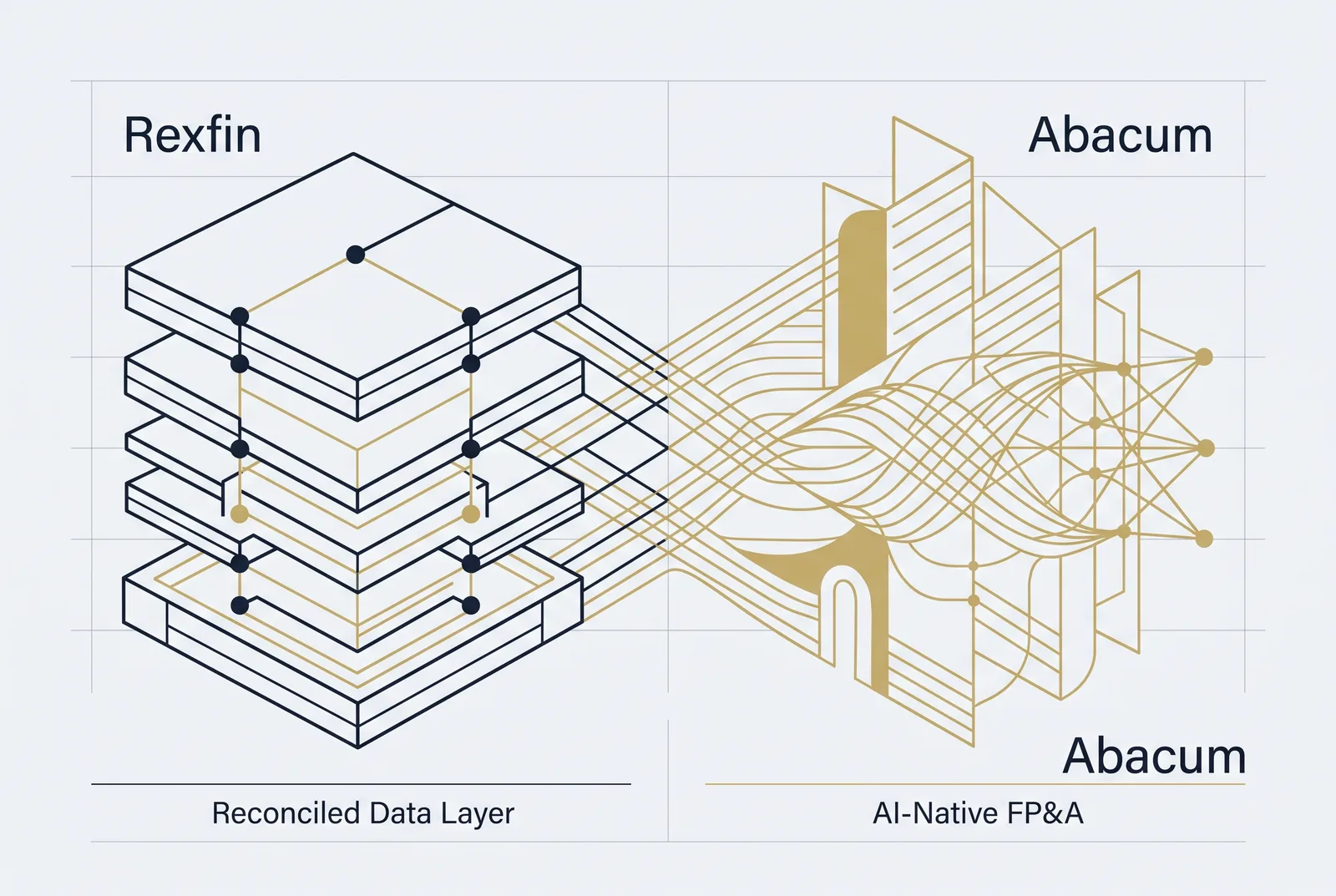
These two products get compared a lot, but they are not really after the same job. Abacum is an FP&A platform: budgeting, forecasting, headcount planning, board reporting, all in one place for a finance team that owns the plan. Rexfin is the financial-modeling layer underneath the AI: it connects your accounting and financial data, reconciles it into one model, and makes sure that when AI answers a number, the number is correct.
If you are a mid-market CFO who wants to replace a sprawl of planning spreadsheets, Abacum is a serious option. If your problem is that AI keeps producing financial figures you can’t trust, that is the gap Rexfin was built for. Here is the honest version of how they line up.
At a glance
| Abacum | Rexfin | |
|---|---|---|
| Core job | AI-native FP&A platform for planning and reporting | Reconciled financial-modeling layer that feeds AI exact numbers |
| Best for | Mid-market SaaS and recurring-revenue finance teams | Teams that need AI to query financials reliably |
| AI approach | Generates commentary and ML projections inside the model | Retrieves audited figures, calculates deterministically |
| Data reconciliation | Pulls from ERP/HRIS and calls the matching step “reconcile” | One reconciled model; every figure ties to a source document, with a citation |
| Where numbers come from | The planning model, recalculated in real time | The source ledger, retrieved exactly |
| Number traceability | ”Glass Box”: right-click a cell, see the formula logic inside the model | Click a figure, see the filed document and page it came from |
| MCP / AI-operator access | Abacum Intelligence connects to Claude, ChatGPT, Gemini (reads the planning model) | Rexfin’s MCP server connects the same clients to a reconciled, cited ledger |
| Setup | 4–8 weeks typical; longer for complex setups | Connect sources, build one model |
| Pricing model | Quote-based tiers, implementation included | Talk to us |
Where Abacum is strong
Abacum is built for a specific buyer, and it shows. Mid-market SaaS companies that live on ARR, net dollar retention, cohort revenue, and headcount-driven OPEX get a platform that already speaks their language. Driver-based forecasting, ARR waterfalls, customer-level profitability, rolling budgets with version control: these are first-class features, not bolt-ons. The G2 score (4.8 from 140-plus reviews) reflects that fit.
Implementation is genuinely fast for the category. Where legacy FP&A tools can run three to six months, Abacum targets four to eight weeks, and it pulls from NetSuite, SAP, Salesforce, HRIS and billing systems so finance stops rebuilding the same CSV every month. For a team trying to get off spreadsheets without an enterprise rollout, that speed matters.
Its AI story is also more thoughtful than most. Abacum Intelligence is a five-layer architecture (Context, Modelling, Narrative, Scenario, Workflow Intelligence) that runs inside the model, auto-writing variance commentary and explaining why a number moved. It also ships its own MCP integration, connecting Claude, ChatGPT and Gemini to that model with role-based access preserved: a more serious AI architecture than most FP&A vendors bother to build.
Where Abacum leaves gaps
The gaps show up at the edges. New users report a steep learning curve, and full implementations can stretch well past the marketed window: some G2 reviewers describe four-to-six-month rollouts for complex models. Performance can slow once those models get large, which is exactly when you lean on the tool most.
The AI has honest limits too. Abacum’s own framing puts forecast accuracy within roughly 5–10% for stable, recurring revenue, and accuracy drops for volatile or non-recurring patterns. Several reviews note a thin native scenario engine, and integration breadth outside ERP and HRIS is narrower than the headline number suggests. Excel stays in the loop for plenty of teams through export and import.
None of this makes Abacum a bad tool. It means the AI is generating and projecting on top of a planning model. When you ask it a hard number, you are trusting the model’s estimate, not a figure that traces straight back to the ledger.
Abacum also calls its own trust story “Glass Box”: right-click any cell, inspect the logic, every assumption surfaced. Worth naming directly, because it sounds like Rexfin’s own pitch and isn’t quite the same claim. Glass Box is model-internal auditability: the trace stops at the formula inside Abacum’s planning model. Rexfin’s traceability is source-grounded citation: the trace continues past the model to the filed document or ledger entry, with a page reference. Abacum shows you the recipe; Rexfin shows you the recipe and the receipt, the same distinction that separates every “glass box” or “observability” claim in this category from an actual non-hallucination guarantee, laid out fully in explainability vs. verifiability.
Abacum has also started using Rexfin’s own word: /product/data promises to “clean, map, and reconcile in real time,” and its HR and roll-ups pages talk about reconciling variances and multi-ERP data. Same word, different guarantee. Abacum’s “reconcile” means matching and deduping records into a live planning model; Rexfin’s means tying every figure to a source document with a page-level citation. Only one means the number can be proven, not just shown.
Abacum’s security page (SOC 2 Type II, ISO 27001, GDPR, group-based access) is solid on data protection and silent on AI-specific risk: no prompt-injection defense, no agent-decision logging, no model-risk framework. Rexfin publishes prompt-injection defenses, SOX-ready decision logging, and service-account attribution as checkable pages Abacum’s own security page doesn’t cover.
Where Rexfin is different
Rexfin does not try to be your planning suite. It sits a layer down. It connects your ERP, accounting system and spreadsheets, then builds one reconciled financial model where every figure ties back to its source. That model is what AI talks to.
The practical difference is in how a number gets produced. When AI sits on raw data, it tends to guess: it pattern-matches a plausible value and hands it over. Rexfin makes AI retrieve the exact figure instead, run the calculation deterministically, and run scenarios on reconciled inputs. Ask for Q3 gross margin and you get the real one, traceable to the books, not an approximation that’s close enough to be dangerous. Numbers tie out. That is the whole point.
Rexfin’s MCP server carries the same distinction into the agent world: Abacum Intelligence’s MCP connects an AI to its planning model, a projection; Rexfin’s connects the same clients to the reconciled ledger underneath. Same protocol, different guarantee, a pattern worth watching across this whole category, not just Abacum (more on MCP as transport, not verification).
Which should you pick
Pick Abacum if your core need is an FP&A platform: you want one place to budget, forecast revenue and headcount, and produce board-ready reports, and your business has the steady recurring revenue its models do best with. It is a strong, well-rated fit for that buyer.
Pick Rexfin if your problem is trust in the numbers AI gives you. If you are wiring AI into financial workflows and need it to pull exact, reconciled figures instead of estimates, Rexfin is the layer that makes that safe. The two can even coexist: Rexfin feeds clean, source-tied data; your planning tools and AI sit on top.
FAQ
How does Abacum’s pricing compare to Rexfin? Abacum doesn’t publish list prices. It sells quote-based annual tiers with implementation bundled in, so the real number depends on seats, modules and how complex your model is. Rexfin is also quote-based, but it’s priced as a data layer rather than a full planning suite, so the two rarely map one-to-one. Ask both for a quote against the same scope and compare the implementation line carefully.
How hard is it to migrate from spreadsheets or another FP&A tool? With Abacum you rebuild your plan inside its model, which is the four-to-eight-week setup most teams see. Rexfin doesn’t replace your plan. It connects to the ERP and accounting systems you already run and reconciles them, so there’s no model to recreate from scratch. If you’re moving off Excel for planning, Abacum is the migration. If you’re trying to make existing systems queryable by AI, Rexfin sits on top of them.
Is my financial data secure, and where does it live? Both products connect through read access to systems like NetSuite, SAP, Salesforce and your HRIS rather than copying raw ledgers around by hand. Rexfin’s model keeps each figure tied to its source record, so you can trace any number an AI returns back to the entry it came from. That audit trail is part of the security story, not just the accuracy one.
How accurate are the numbers each one produces? This is the core split. Abacum frames forecast accuracy at roughly 5–10% for stable recurring revenue, and that range widens for volatile or one-off patterns, because it’s projecting on a model. Rexfin doesn’t forecast a number and hope. It retrieves the actual figure from the books and runs the math deterministically, so a Q3 gross-margin answer ties out to the ledger every time.
If reliable numbers are the thing standing between you and using AI on financial data, book a demo and we’ll show you how the model holds up.
In practice
While you evaluate Abacum, this is what a verified number looks like.
Export review
FY2025 board pack.xlsx
- 2 extractors agree
- Reconciles to printed total
- Identity checks pass