
Audit Trails That Record Decisions, Not Just Actions: What SOX-Ready Finance Agents Must Log in 2026
Auditors no longer accept a log that the agent did X. They want what it saw, what it decided, why policy allowed it, and what changed in the ledger. Here is the standard.
By The Rexfin team
A controller I spoke with this spring described a moment that is becoming common. Her external auditor pulled up a journal entry posted by an AI agent during the quarterly close, then asked a question the log could not answer: not who posted it, but why the agent thought it was allowed to. The system had recorded the action. It had recorded the timestamp, the user token, the amount. What it had not recorded was the figure the agent retrieved, the policy it checked, the threshold it compared against, and the reasoning it produced before it acted. The walkthrough stalled there.
That gap is the whole story of 2026. The audit bar moved, and a lot of finance tooling did not move with it.
The old log answers the wrong question
For decades a SOX-relevant audit trail meant a record of actions: who did what, when, to which record. That model assumes a human is the actor and the human’s judgment lives in their head, reachable through inquiry and walkthroughs. You ask the analyst why they booked the accrual, they explain, you tie out the support, you move on.
An autonomous agent breaks that assumption. The judgment does not live in anyone’s head. It lives in a transient model call that, by default, leaves no trace. If you only log the action, you have logged the easy 20% and lost the part auditors actually care about: the decision.
COSO’s guidance this year is blunt about it. Prompts, inputs, outputs, model and configuration versions, and evidence of human review are treated as part of the audit trail, not adjacent to it. The stated test is whether the captured record is sufficient to reconstruct what the AI acted on and demonstrate the control functioned as designed. Reconstruct is the operative word. A line that says agent_posted_JE_4471 reconstructs nothing.
Four things a decision-level log has to carry
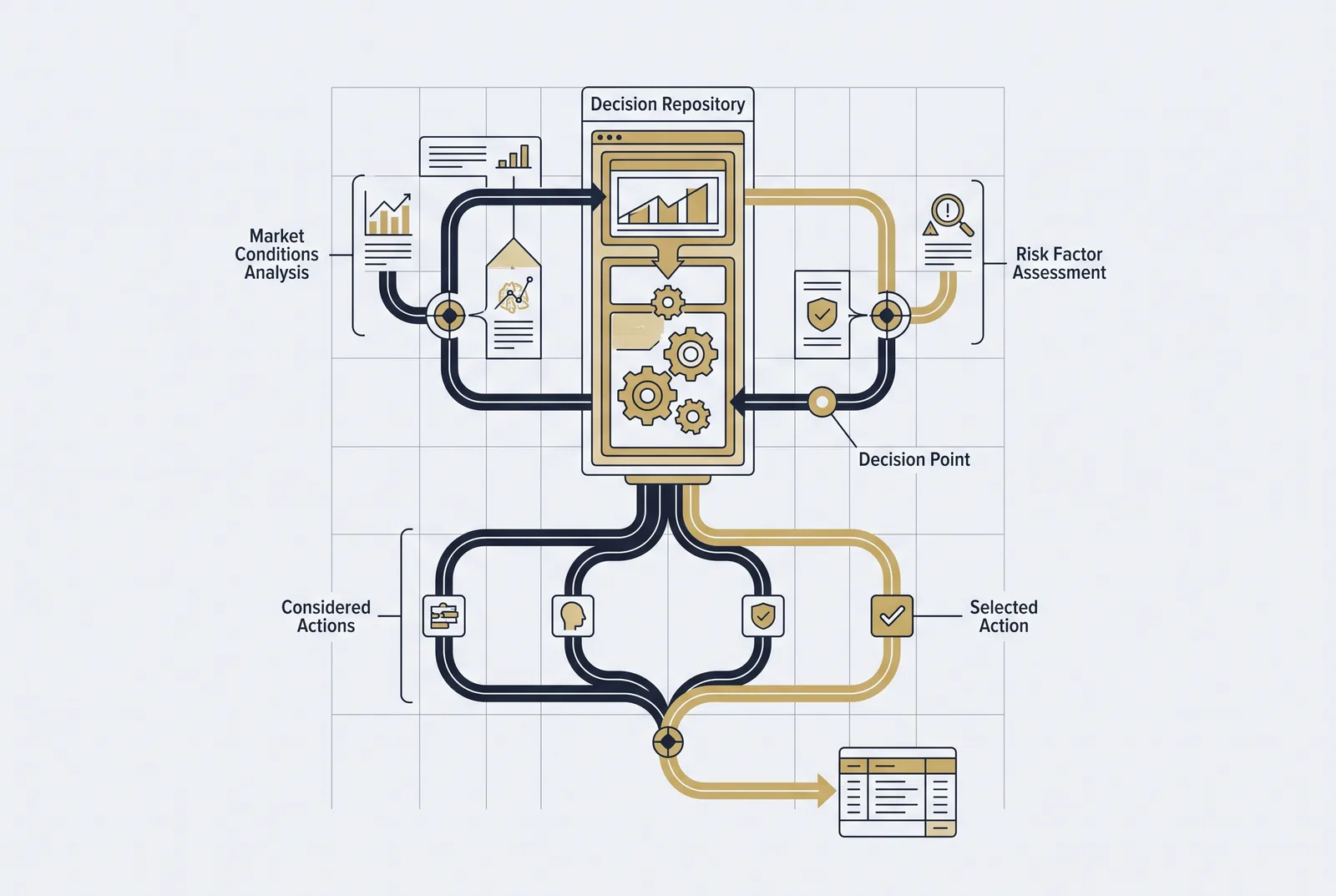
If you take the reconstruction standard seriously, an entry for any consequential agent step needs four layers. Most failures are a missing layer, not a missing log.
What the agent saw. The exact figures, records, and context fed into the decision, pinned to their source. Not “revenue for Q1” but the specific reconciled balance, the version of the underlying data, and the lineage back to the ledger. If the input cannot be reproduced, nothing downstream is provable.
What it decided. The output, plus the candidate paths it considered. A reconciliation match has a confidence; a flagged anomaly has a magnitude; a proposed entry has alternatives that were ranked and rejected. Logging only the chosen path hides whether the choice was reasonable.
Why policy allowed it. The control that authorized the action and the evaluation that passed. This is the layer almost everyone skips. “Agent had permission” is not it. The record should show the agent operated inside a defined bound (an approval threshold, an autonomy tier, a segregation-of-duties rule) and that the specific decision satisfied that bound at that moment.
What changed downstream. The link from the decision to its effect in the books. If the agent’s decision caused a journal entry, a forecast revision, or a reclassification, the trail must connect the two. Auditors are explicit now that end-to-end transaction traceability is the expectation, and that each AI touchpoint should map to the financial assertion it influences: existence, completeness, valuation, and so on.
Put those four together and you can answer the auditor’s question before it is asked. Leave one out and you are back to inquiry, except there is no human to inquire of.
You cannot log the input you cannot trace
Here is the part that gets uncomfortable, and it is worth saying plainly because it limits how much logging alone can buy you.
A decision log is only as trustworthy as the figures inside it. If the agent pulled “cash balance” from a spreadsheet that nobody reconciled, you can log that beautifully (full prompt, full rationale, immutable timestamp) and you have produced a perfect record of an unreliable decision. The log proves the agent behaved consistently. It does not prove the decision was right, because the input never tied to anything.
This is why the 2026 lineage conversation and the agent-logging conversation are the same conversation. Auditors are asking for column-level lineage that traces individual financial fields through every transformation back to source, precisely so they can prove the data feeding an automated control was complete and accurate before the control touched it. A decision-level log that references untraceable numbers satisfies the form and fails the substance.
So the real prerequisite for a SOX-ready agent is not a better logging library. It is a reconciled source of truth (one financial model that ties out to the ledger) that every figure the agent sees can be traced to. Get that right and the log becomes meaningful: every input has lineage, every output points back to a source, and “what the agent saw” is a reproducible fact rather than a hopeful assertion. This is the same foundation that makes a broader audit trail for AI in finance hold up under a walkthrough.
Reasoning and computation are not the same trail
One more distinction that auditors are starting to probe. When an agent “calculates” a covenant ratio or a variance, what did the math?
If the language model produced the number, your decision log is recording the output of a system that is, by design, probabilistic. The same prompt can yield a different figure on a different day, and there is no deterministic artifact to re-run. That is very hard to defend as an automated control, because the benchmarking relief auditors offer for automated application controls assumes the control logic is stable and the result is reproducible.
The defensible pattern separates the two. The agent reasons about which calculation to run and which figures to use; a deterministic engine performs the computation; the log captures the inputs, the function invoked, and the exact result. Re-run it next quarter with the same inputs and you get the same number, every time. That reproducibility is what turns a log entry into evidence. We make the full case for this split in why finance agents must call tools, not compute, and it pairs naturally with governed autonomy, because the policy layer that bounds an agent’s actions is also the layer that produces the “why was this allowed” line in the log.
What to ask your stack before the auditor does
A short, unglamorous test. Pick one decision your agent made last quarter and try to answer, from the log alone: What figures did it see, and can I trace each to source? What did it decide, and what did it reject? Which control authorized it, and did the decision pass that control? What changed in the ledger as a result?
If any answer requires you to shrug, ask a person, or re-run a model and hope, you are not SOX-ready: you are SOX-exposed, and continuous monitoring will surface it faster than annual sampling ever did.
The agents are going to keep posting entries and revising forecasts; that train has left. The question is whether each of those moves leaves behind a record an auditor can reconstruct without you in the room. That record starts with figures that trace to a reconciled source of truth, runs through a deterministic engine, and ends in the ledger. If you want to see what a decision-level trail looks like when it is built on that foundation, book a demo and bring your hardest journal entry.
Part of Agentic AI in Finance Needs a Reliable Numbers Layer First