
Governed Autonomy vs. Human-in-the-Loop: Why Approving Every Agent Action Does Not Scale
Approving every agent action caps finance AI at human review speed. Governed autonomy moves humans above the system, setting policies that hold only on reconciled numbers.
By The Rexfin team
A controller I spoke to last quarter had quietly become a bottleneck. Her team had deployed an AP agent that matched invoices, flagged exceptions, and queued payments. It worked. The problem was the approval gate: every action the agent proposed landed in her queue. By month-end she was rubber-stamping 400 items a day, half of them under $200, and she admitted she had stopped reading the small ones. The agent was fast. The human in front of it was not. So the whole system ran at her speed, and her attention had already degraded into a formality.
That is the failure mode nobody warns you about when they sell you “human oversight.” Putting a person inside every transaction sounds safe. In practice it does two bad things at once. It caps throughput at the rate one reviewer can think, and it trains that reviewer to approve without looking, because no human sustains genuine scrutiny across hundreds of near-identical decisions. You end up with the cost of a control and the assurance of none.
The approval gate is a speed limit
Human-in-the-loop made sense when AI was a suggestion engine and volumes were low. A handful of recommendations a day, each reviewed properly, is a reasonable design. It stops being reasonable the moment an agent can execute thousands of actions an hour. At that volume the gate is no longer a safeguard; it is a queue, and queues have a maximum drain rate set by the slowest component. The slowest component is the person.
Gartner’s framing here is blunt: agents that observe, advise, act with approval, and act autonomously do not carry the same risk, and treating them the same way is a path to failed deployments. The firm has gone as far as warning that applying uniform governance across agents will produce enterprise failure, with security gaps and production rollbacks. The corollary that finance leaders miss is the inverse error. If you apply the strictest control, per-action human approval, to every workflow regardless of risk, you do not get more safety. You get a system that cannot scale and a reviewer who has stopped reviewing.
So the question is not “human or no human.” It is where the human sits relative to the work.
Governed autonomy moves the human up a level
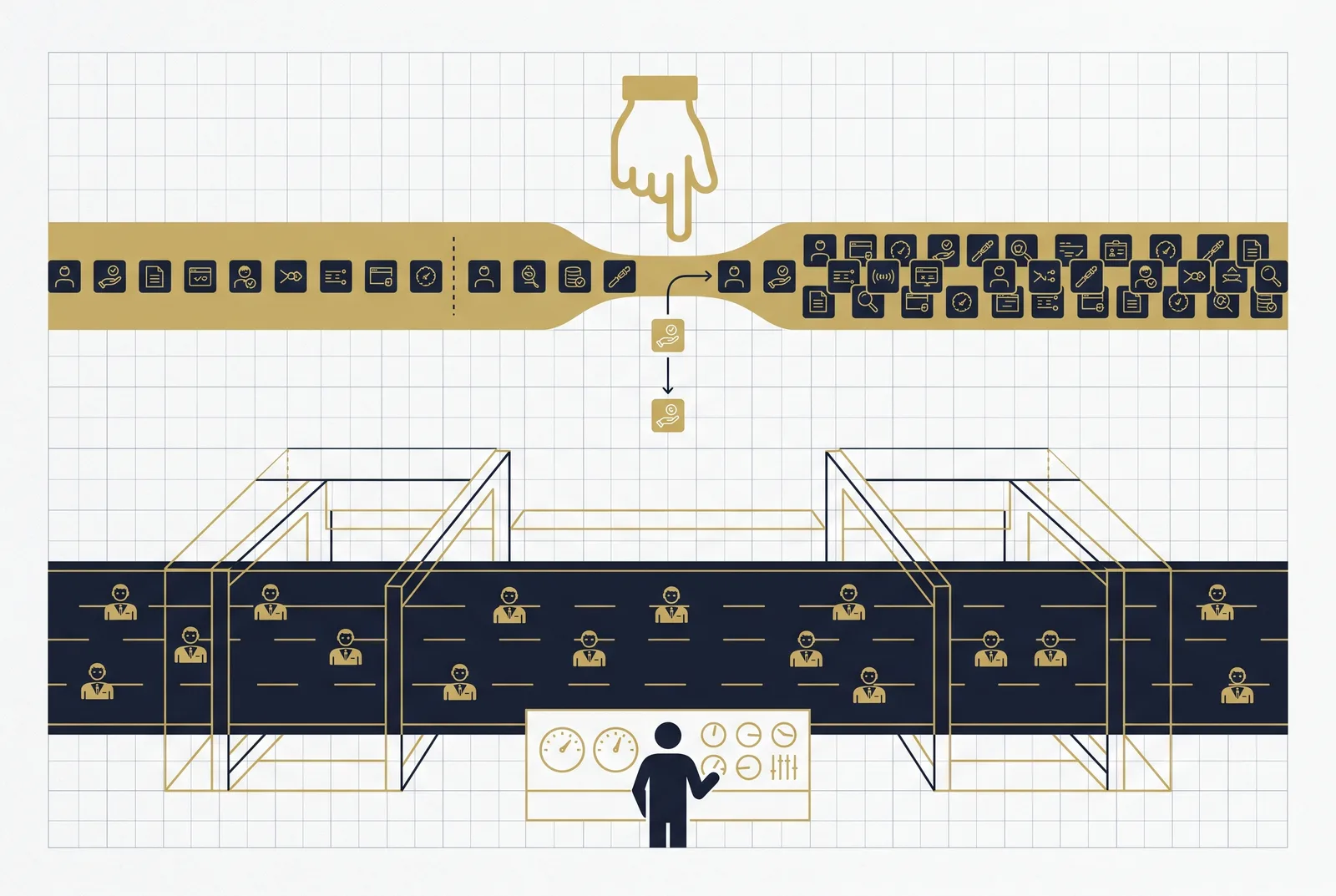
The 2026 shift, and you can read it in the Berkeley CMR operating-model work and the WEF board playbook, is to stop placing humans inside transactions and start placing them above the system. Instead of approving the agent’s output, you set the policy that constrains it: spending thresholds, which accounts it can touch, what reversibility a given action requires, when it must escalate. The human designs the boundaries. The agent operates freely inside them and stops cold at the edge.
This is “human-on-the-loop” rather than human-in-the-loop. A useful pattern from the agentic operating-model literature is a separate guardrail check that intercepts an agent’s action before it executes. If a procurement agent initiates a $50,000 payment when its behavioral baseline is $10,000, the guardrail blocks the action and routes it to a person. Below the threshold, the agent proceeds and the human never sees it. The reviewer’s attention is now spent only on the 3% of cases that actually warrant judgment, which means it is real attention again.
The economics flip. You stop paying for a reviewer to glance at 400 items and start paying for one to genuinely interrogate twelve. Same headcount, vastly more assurance, and the agent runs at machine speed for everything routine. This is the only version of scaling that survives contact with a board.
A boundary is only as trustworthy as the number it tests
Here is the part the governance vendors skip, and it is the part that decides whether any of this holds up.
A policy like “auto-approve below $10,000, escalate cash impact above 5% of the period budget, never touch a closed period” is a set of rules evaluated against numbers. The whole architecture of governed autonomy rests on those numbers being right. If the agent’s view of “cash impact” or “period budget” or “remaining balance” is wrong, the boundary fires at the wrong moment. Worse, it fires silently wrong: the agent confidently auto-approves something it should have escalated, because the figure it checked against the threshold was off.
This is where most agentic finance stacks quietly fail. The agent reaches into the ERP, pulls raw general-ledger fields, and the language model does fragile probabilistic arithmetic to decide whether a threshold is crossed. We have written before about why finance agents must call tools, not compute: an LLM predicts what a number should look like, it does not run the formula. A guardrail built on a predicted number is not a guardrail. It is theater with a confidence score attached.
Governed autonomy needs the boundary conditions to be deterministic and reconciled. The threshold check has to run against a single financial model that ties out to the ledger, with the math executed by an engine rather than the model. That is the difference between a policy you can defend to an auditor and a policy you are hoping holds.
What this looks like in practice
Concretely, the workflow that scales has three parts, and they map to where Rexfin sits.
First, one reconciled model. Connect QuickBooks, Xero, NetSuite, Sage, your warehouse, or uploaded statements into a single source of truth that ties out to the ledger. Every threshold, baseline, and budget the policy references reads from this model, not from whatever the agent happened to scrape.
Second, deterministic evaluation. When the agent considers an action, the threshold logic runs through a deterministic calculation engine, not the LLM. “Is this above 5% of period cash” returns the same answer every time and traces to source. The boundary becomes auditable.
Third, the human above the system. Your team sets and tunes the policies, reviews only the escalated exceptions, and inspects a trail that records not just what the agent did but what figure it checked and why the policy allowed or blocked it. That last point matters for compliance, and it connects directly to what SOX-ready agents must log: decisions, not just actions.
None of this removes the human. It relocates them to where their judgment compounds instead of where it gets ground down.
The takeaway
Approving every agent action is not caution. It is a design that buys you the appearance of control while capping your finance function at the throughput of one tired reviewer. Governed autonomy is the alternative that actually scales, but it only works if the boundaries are computed on numbers you trust. A threshold tested against a hallucinated figure is worse than no threshold, because it fails quietly and with apparent rigor.
If you are designing agent autonomy this year, design the policies first and then ask the harder question: what are those policies reading from? If the answer is “the LLM’s best guess at the ledger,” you have not built governance. You have built a faster way to be wrong. Book a demo and we will show you what governed autonomy looks like when the boundaries sit on a reconciled model.
Sources: Auditoria, Finance AI 2026: Human-in-the-Loop Out, Governed Autonomy In; California Management Review, Governing the Agentic Enterprise; World Economic Forum, A board playbook for governing agentic AI; Gartner, Applying Uniform Governance Across AI Agents Will Lead to Enterprise AI Agent Failure.
Part of Agentic AI in Finance Needs a Reliable Numbers Layer First