
The SaaS Metrics an AI Can Actually Get Right (When It Computes Instead of Talks)
ARR, NRR, gross margin, CAC payback, magic number, burn multiple: where LLMs quietly drift, and why a reconciled model plus a deterministic engine fixes it.
By The Rexfin team
Ask a general-purpose AI assistant for your net revenue retention and it will give you a number. It will look clean, land in the low hundreds, and read like an answer. The problem is that it is almost never your number. It is a plausible number, assembled from a definition the model half-remembers, a denominator it guessed at, and revenue timing it never checked against your ledger. For a SaaS CFO, that gap between plausible and correct is the whole job.
SaaS metrics are unusually easy to get wrong and unusually hard to notice when you have. ARR, NRR, gross margin, CAC payback, the magic number, burn multiple: none of them are hard arithmetic. They are hard definitions computed against messy source data. When an LLM “talks about” one of these metrics rather than computing it against reconciled actuals, it drifts in ways that are invisible until a board member or a diligence team catches it. Here is where the drift lives, and what it takes to close it.
”Which ARR?” is the real trap
There is no single ARR. There is contracted ARR, billed ARR, live/active ARR, ARR net of committed churn, and the “ARR” your CRM shows because someone summed the opportunity field. These can differ by double digits in a company with usage-based components, mid-term downgrades, or annual prepays that have not yet gone live.
A language model does not know which one you mean, so it silently picks one (usually whichever definition dominated its training data) and computes as if that were settled. It will not tell you it chose. The same failure shows up in NRR, which is arguably the most abused number in SaaS. Net revenue retention has a specific shape: take a cohort of customers at the start of the period, then measure that same cohort’s recurring revenue at the end, including expansion, contraction, and churn, but excluding new logos. Get any of those boundaries wrong and you get a different answer:
| Common NRR mistake | What it does to the number |
|---|---|
| Including new-logo revenue in the end figure | Inflates NRR, hides churn |
| Mixing MRR and ARR bases across the period | Random drift, often unnoticed |
| Using period-average customers as the denominator | Understates or overstates expansion |
| Counting reactivations as expansion | Overstates retention |
Every one of these is a definitional choice, not a math error. An AI that reasons in prose will make the choice for you and present the result with the same confidence either way. The fix is not a smarter model. It is defining ARR and NRR once, explicitly, and computing that definition against a reconciled cohort every time.
Gross margin: the denominator nobody agrees on
Ask three SaaS finance leads what belongs in cost of revenue and you will get three answers. Hosting and infrastructure, yes. But what about customer success salaries? Support? Third-party API and data costs passed through to customers? Amortized capitalized software? DevOps? Payment processing fees?
SaaS gross margin swings by 10 to 20 points depending on where you draw that line. So when an AI reports “your gross margin is 78 percent,” the honest response is: 78 percent under whose COGS definition, against which revenue base, GAAP or adjusted? The model almost never states its assumptions because it does not have firm ones. It reconstructs a reasonable-sounding calculation from fragments and hands you a figure that cannot be reconciled back to any line in your P&L.
This is the same disease as the ARR problem, and it has the same cure: pin the COGS mapping to actual ledger accounts, decide GAAP versus adjusted deliberately, and compute the ratio deterministically so the number ties out to the income statement every time. A margin you cannot trace to accounts is not a margin. It is a guess with a decimal point.
Efficiency metrics fail on timing, not arithmetic
CAC payback period, the magic number, and burn multiple are where deferred-revenue timing quietly wrecks things. The arithmetic is trivial. The inputs are not.
- CAC payback = sales and marketing spend to acquire a cohort, divided by the gross-margin-adjusted recurring revenue that cohort generates per month. The traps: using bookings instead of recognized revenue, forgetting to adjust for gross margin, and misaligning the period of spend against the period of the customers it actually won. S&M this quarter did not win this quarter’s revenue.
- Magic number = net new ARR in a period divided by prior-period S&M. It only means anything if “net new ARR” and “S&M” come from the same reconciled source and the periods line up.
- Burn multiple = net cash burned divided by net new ARR. Cash burn comes off the cash flow statement; net new ARR comes off the recurring-revenue model. If those two live in different systems that were never reconciled, the ratio is fiction.
An LLM working from a pile of exported numbers cannot see that your billed revenue includes annual prepays that inflate a quarter, or that a large one-time services deal is sitting inside what it treated as recurring. It computes the ratio anyway. This is the exact hazard we cover in cash flow forecasting: the moment cash timing and revenue recognition drift apart, every efficiency metric built on top of them inherits the error.
Why “talking about” a metric is the failure mode
Step back and the pattern is consistent. In every case above, the AI produced a number by reasoning about the metric in natural language instead of computing it against reconciled actuals. That is the root cause, not model quality. A probabilistic system asked to both choose a definition and perform the arithmetic will occasionally do both wrong, and it will never flag which.
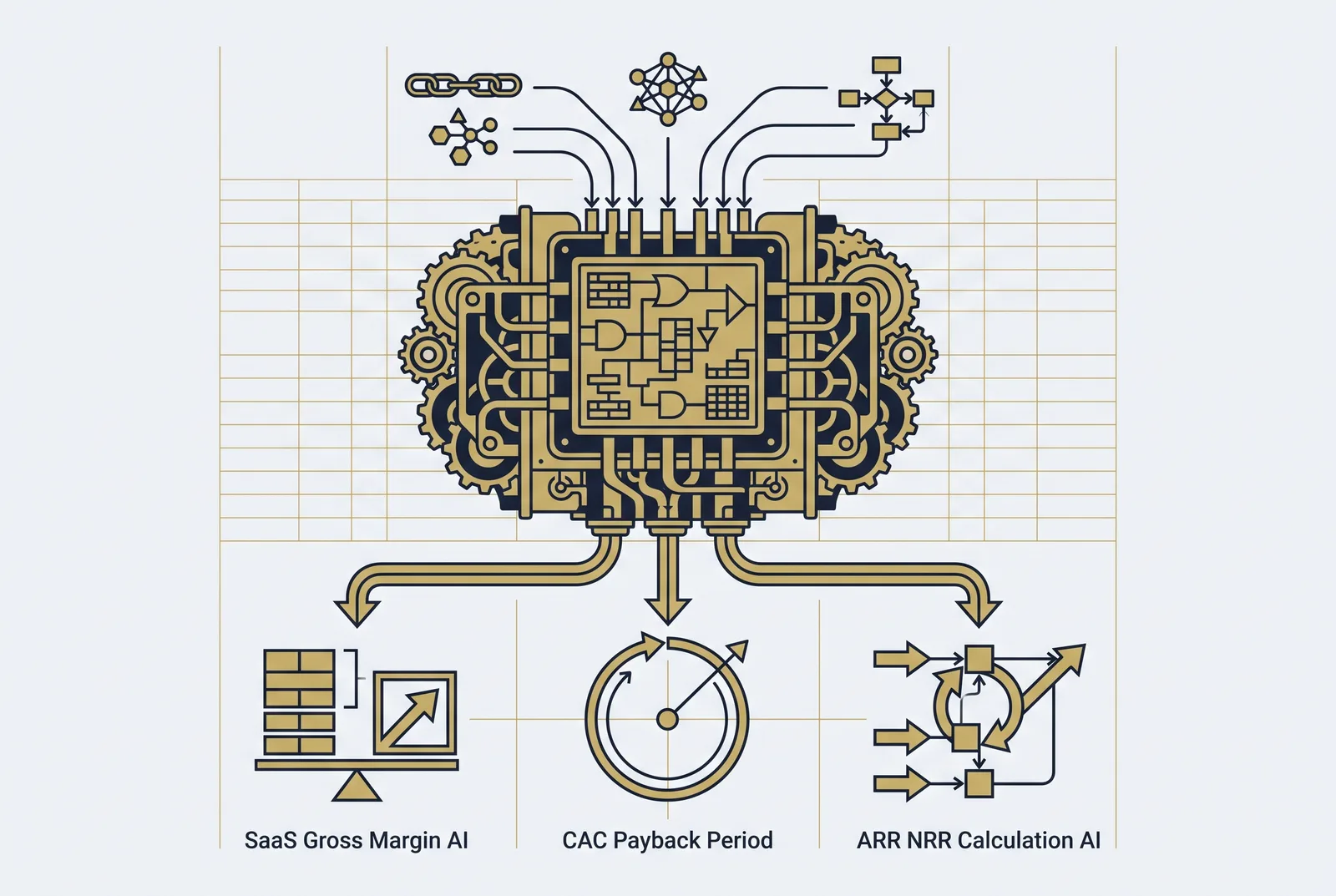
The structural fix is to split those two jobs. Definitions and math belong in a deterministic engine that runs the same way every time. Retrieval, explanation, and “what does this mean” belong to the AI. When you separate them, the metric stops depending on what the model remembered about NRR and starts depending on your ledger. This is the same argument that separates real modeling tools from AI wrappers, the difference we draw out against Datarails and Mosaic: the question is not how fluent the assistant sounds, but whether the number underneath was computed against reconciled data or improvised.
What “computed reliably” actually requires
For a SaaS metric to be trustworthy, three things have to be true at once, and all three fail in the prose-first approach:
- The metric is defined once. ARR means one specific thing. NRR has fixed cohort boundaries. COGS maps to named ledger accounts. GAAP versus adjusted is a stated choice, not a coin flip.
- The math is deterministic. Same inputs, same output, every run. No re-derivation, no drift between Tuesday’s answer and Thursday’s.
- Every figure traces to source. You can click from NRR back to the cohort, from gross margin back to the accounts, from burn multiple back to the cash and ARR that fed it, and show it to an auditor or an acquirer.
That is the architecture Rexfin is built on: connect the accounting, banking, and warehouse data, reconcile it into one model that ties to the ledger, and let a deterministic engine compute the metrics while the AI retrieves and explains. The metric is no longer a thing the model talks about. It is a thing the system computes and can prove.
The takeaway
SaaS metrics are not hard because the formulas are hard. They are hard because “which ARR?” and “which gross margin?” are real questions with real, differing answers, and an AI that reasons in prose answers them silently and inconsistently. The metrics an AI can get right are exactly the ones where you have taken the definition and the arithmetic away from the model and handed them to a deterministic engine sitting on reconciled data. Everything else is a confident number you cannot defend.
For the wider picture, start with the pillar on AI, FP&A automation, and the forecasting foundation. When you want to see your own ARR, NRR, and margins computed against your own ledger and traced to source, book a demo.
Part of AI FP&A Automation: Forecasting You Can Defend in the Board Room